Solar hot water system

About a month ago we got our application approved for our solar hot water rebate through the Massachusetts CEC (a “quasi-public” organization). We were awarded $2425 for our solar hot water and monitoring systems. I was also hoping to apply for a Massachusetts zero interest HEAT loan, but those are, unfortunately, for existing construction.

Our system:
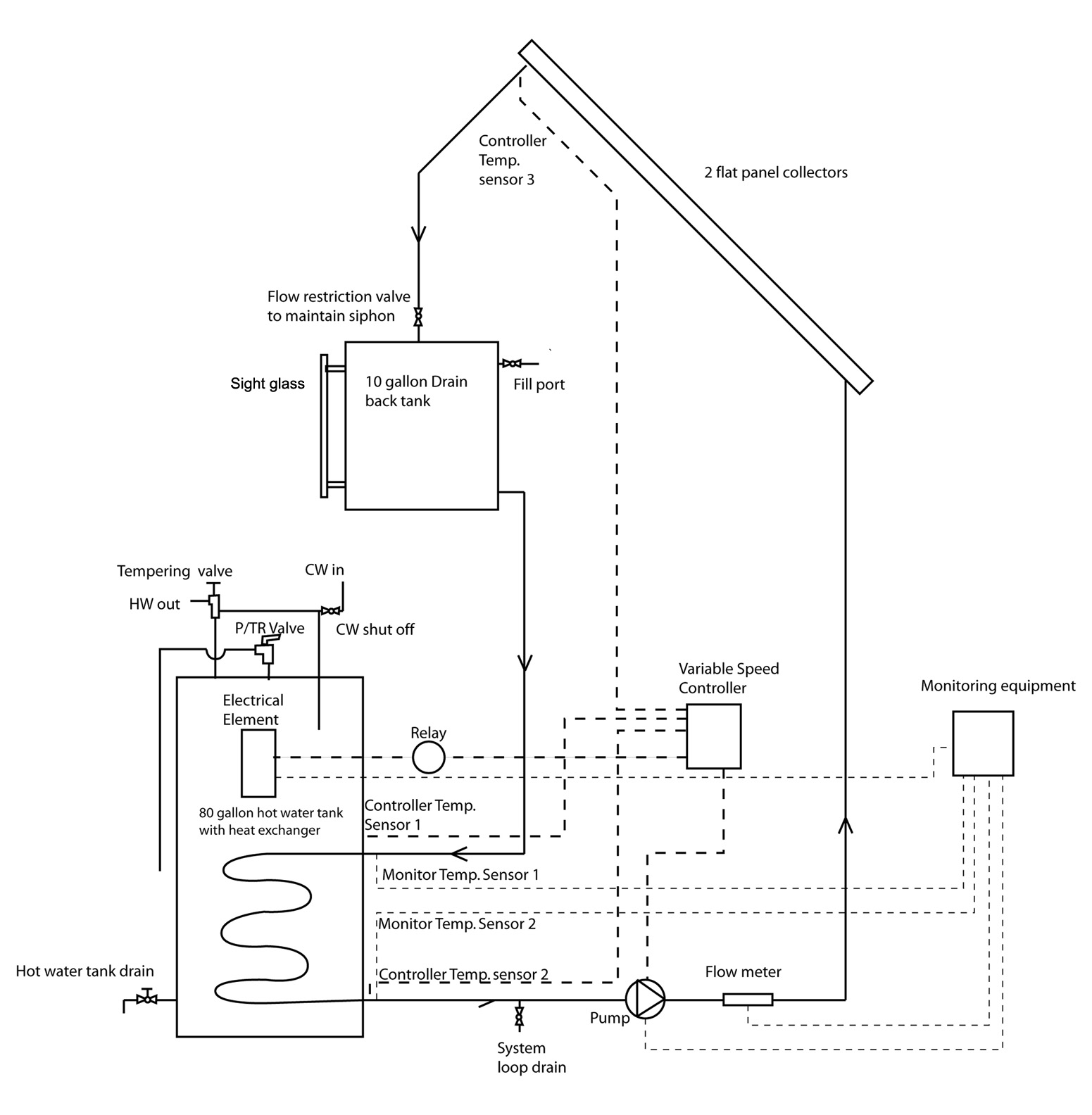
Drain Back Solar hot water diagram

Here is the diagram I created for the drain back solar hot water system.

Our equipment list:

  • (2) Sun Earth EC-32 panels (now EC-40)
  • Heat transfer products SuperStor Contender Solar 80 Gallon hot water tank with electric back up and internal heat exchanger
  • AET 10 gallon drain-back tank
  • Resol Deltasol BS Plus differential controller with variable pump speed control
  • Sun Reports Apollo 1 monitoring system with Internet reporting
  • Grundfos UPS 15-58 pump (with check valve removed)
  • Grundfos VFS 2-40 flow-meter

On 7/29 our solar hot water panels, which we purchased through Northeast Solar of Hatfield MA, arrived. Good news bad news time.
Bad news: The wrong ones were delivered.
Good news: We were allowed to keep them.
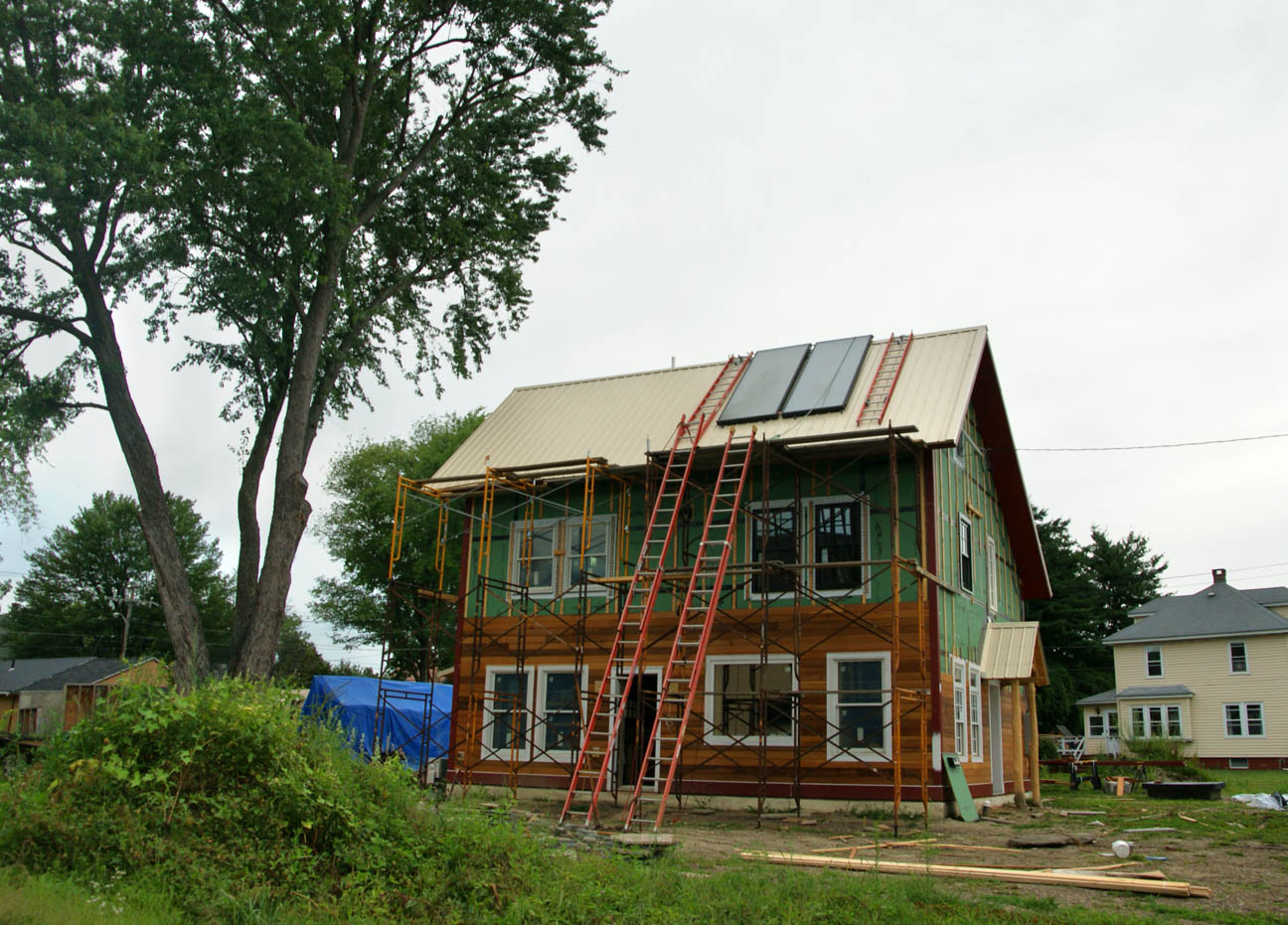
What happened is Northeast Solar’s distributor delivered 4×10 panels instead of 4×8. Since they operate out of Cape Cod they weren’t about to drive back and forth to correct the matter. So we got an extra 16 square feet of panel for free! We weren’t sure at first if the panels would even work for us and we spent about 20 minutes of head scratching to make sure they would fit on our roof, which, subtracting the over-hang, is only 10.5 feet. In the end, as you can see in the photo below, the panels stick up several inches past the peak of the roof.

On 8/3, with the generous help of Dan and Ashley we mounted the panels on the roof without incident. The larger panels were certainly a challenge to lift though. Adam swears they weigh more than the 141 pounds that the SRCC data sheet claims.
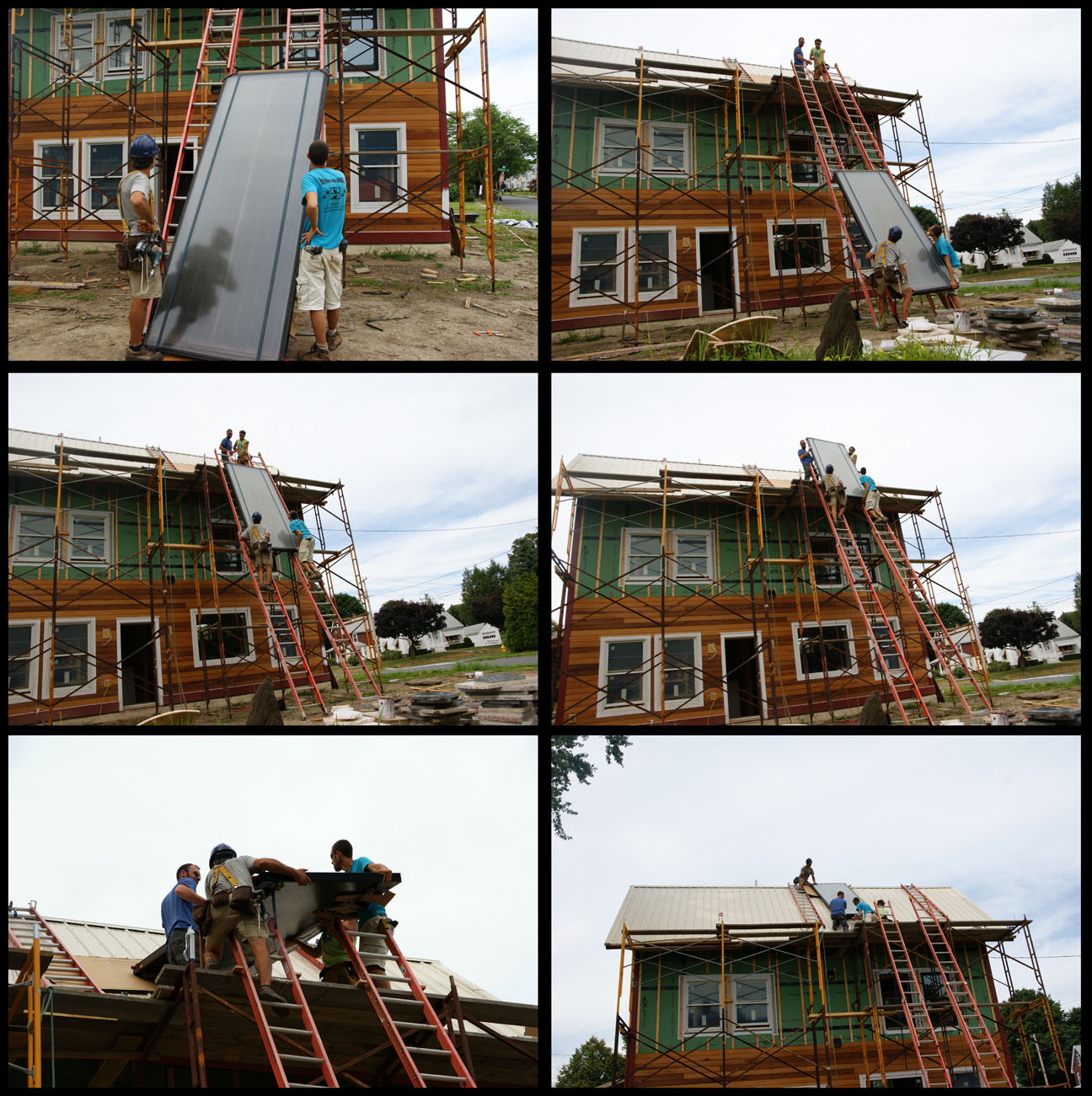
Solar hot water panel raising slide show

Photos by Hannah

Solar hot water panels mounted

Solar hot water panels mounted. Although it is not obvious in this picture, you can tell from the image below that the panels are not straight on the roof. This is no accident. This is a drain back system, where, if the sensor detects that it is too cold out, or there is no need for heat in the main tank, it automatically tells the pump to stop pumping. The water then drains back into the drain back tank. In my opinion, this type of "stagnation protection" technique is better than the more common use of pressurized antifreeze combined with a heat dump if there is too much heat in the system.
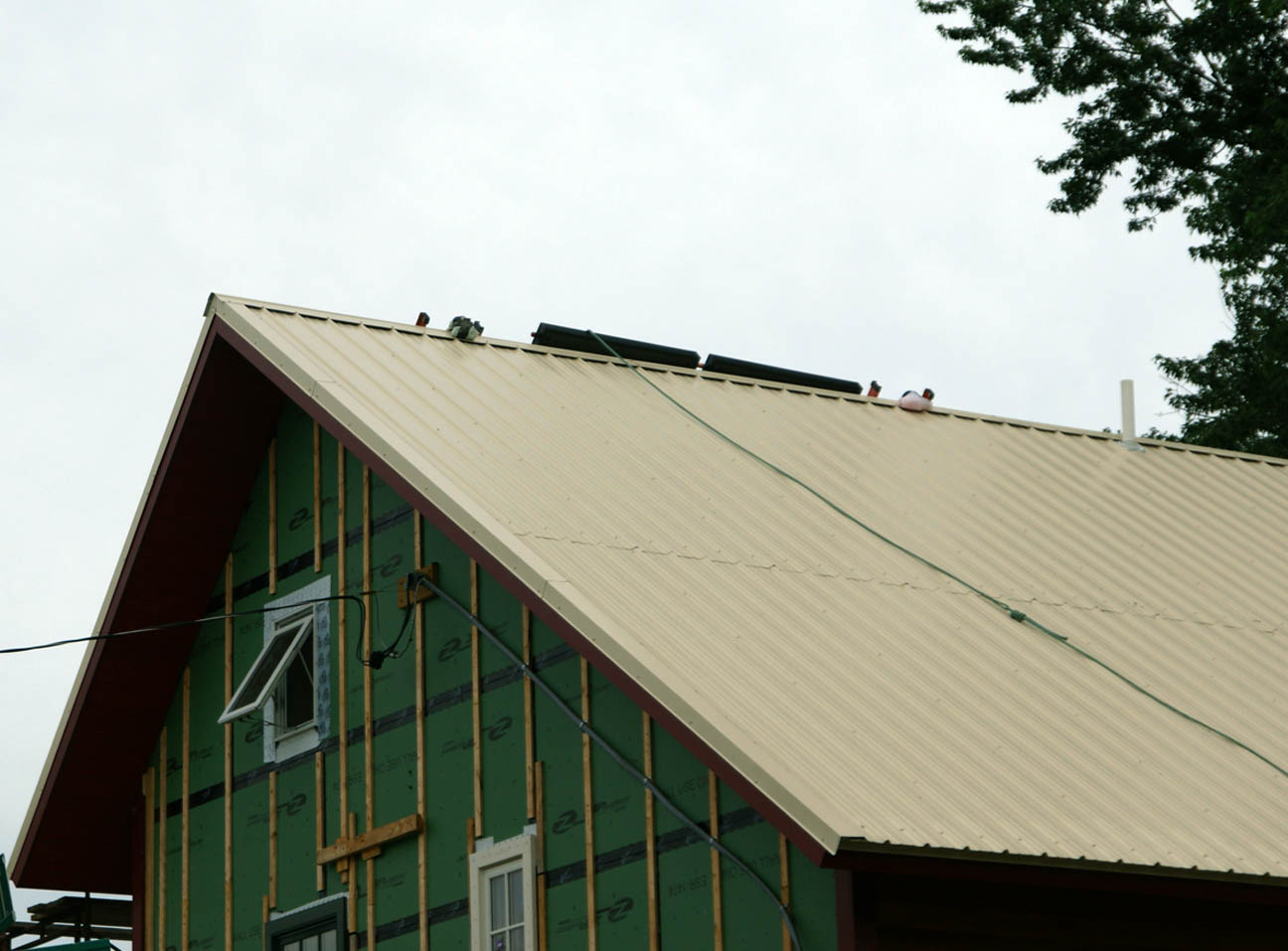
Solar hot water panels peaking over the roof

Solar hot water panels peeking over the roof

Orienting the house due South

This past week Adam’s friends Dave and Nancy, who have built their own custom home and blogged about it at http://nancydavebuildhouse.blogspot.com stopped by for a visit. In one of our conversation’s we discussed orienting our homes due South. It struck me that the method I used would be worth sharing since it was fairly creative. I retrieved that neighborhood satellite image from Google maps and imported into Archicad, where I already had created an accurate plot plan based on the original survey. I then measured the angle between Vernon St. and due South. From that, I laid out the four corners of the house in Archicad and measured and triangulated the theoretical distance from the corners of the property to the corners of the house. Although we didn’t have any pins available to us, my neighbor had done an unofficial survey for us so it was easy to transfer the triangulated distances to reality.

This method is only available to those who have straight lines from streets or other structures that show up on a satellite image and are close to the construction site.

Google maps satellite 10 Charles st Aug 2010

You can see that our foundation is perfectly square with the image frame indicating our house is indeed pointing exactly due South.

Ductless minisplit

On August 2nd, Mike Hubbard, of Hubbard Heating and Cooling, installed our ductless minisplit AKA air source heat pump. This unit will serve as our primary heat source for the house. It works much like an air conditioner or refrigerator. All three use what is called the refrigeration cycle to remove heat from one location and put it in another. In short, there is a copper loop that carries a refrigerant fluid (formerly freon, now R410A) that has a really low boiling point in it. Along this loop is a pump (compressor) that circulates the refrigerant. Also in the loop is a choke point or expansion valve that causes the fluid to expand once it passes through. When a gas/fluid expands it becomes cold (think using a spray paint or aerosol can). Put a radiator on the pipe after the expansion valve, blow a fan over it, and you can effectively extract the cold off of the pipe. This part of the refrigeration cycle is called the evaporator. The fluid continues on back to the compressor, which re-pressurizes the fluid causing it to boil and heat up. Have a radiator and a fan at this point in the cycle and you have effectively extracted heat from the condenser side of the refrigeration cycle. One of the nice things about ductless minisplits is that they can both provide heat and air conditioning.

A good good diagram showing the refrigeration cycle can be found at Wikipedia: http://en.wikipedia.org/wiki/File:Heatpump.svg

The most common question is: “But it is, like, 10 degrees outside, how can you extract heat from that?!”

This is fine. It only feels cold. A penguin might think 10 is balmy. Also, keep in mind your freezer is tasked with removing heat out of 20 degree air. That heat is then transferred into your kitchen. As long as molecules are moving there is what we call “heat”. Negative 457 degrees F or zero degrees Kelvin is when there is technically no heat–a far cry from 10 degrees F.

The heat pump we purchased, a Mitsubishi MSZ-FE12NA, operates fine at temperatures down around -5 degrees Fahrenheit.

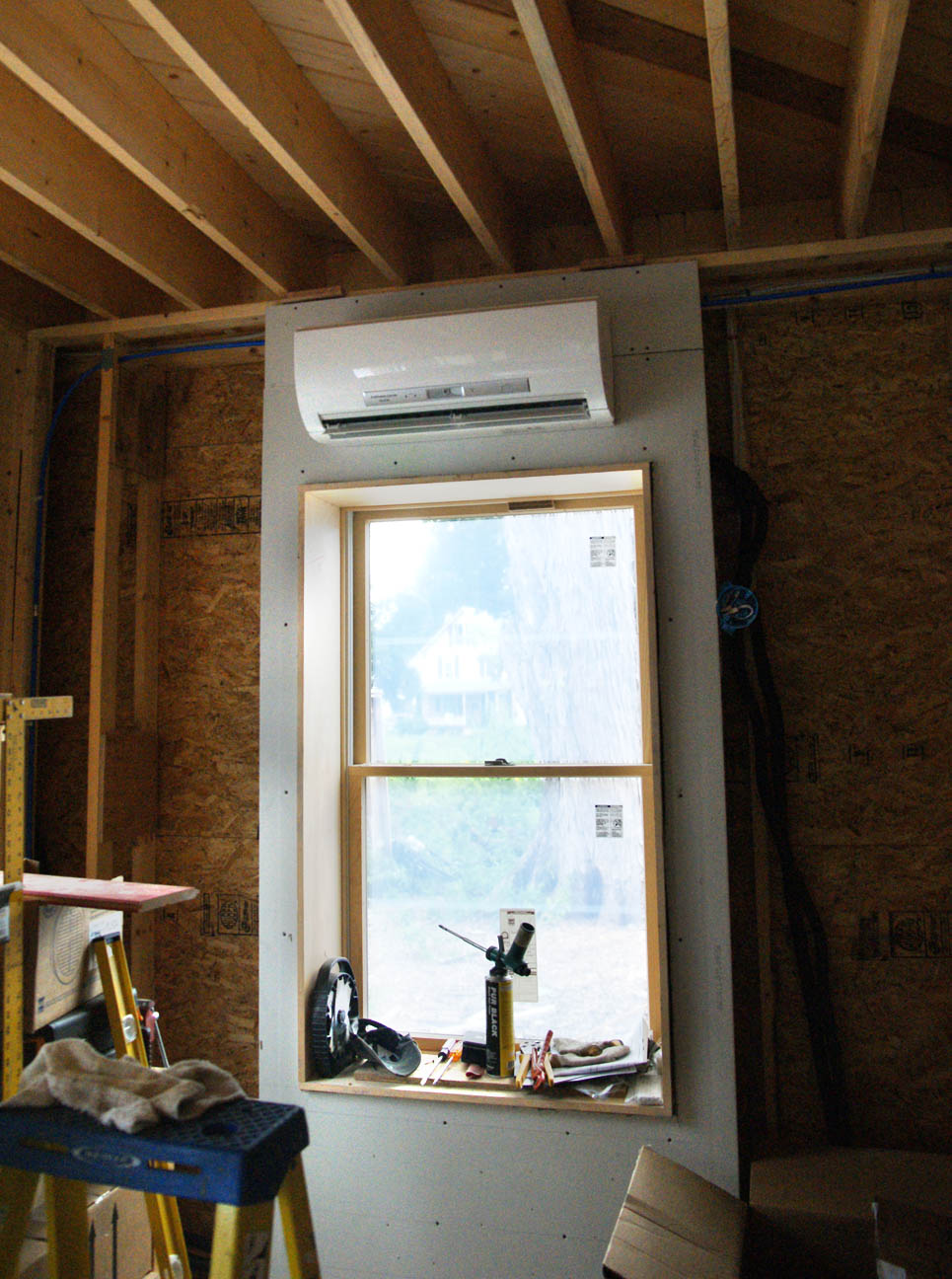
Mitsubishi minisplit Mr. Slim indoor unit

This is the indoor unit for the heat pump. We were originally going to mount in under the window, but I had no idea that it was going to stick on nearly a foot into the room. You can see the refrigerant lines to the right of the sheet rock.

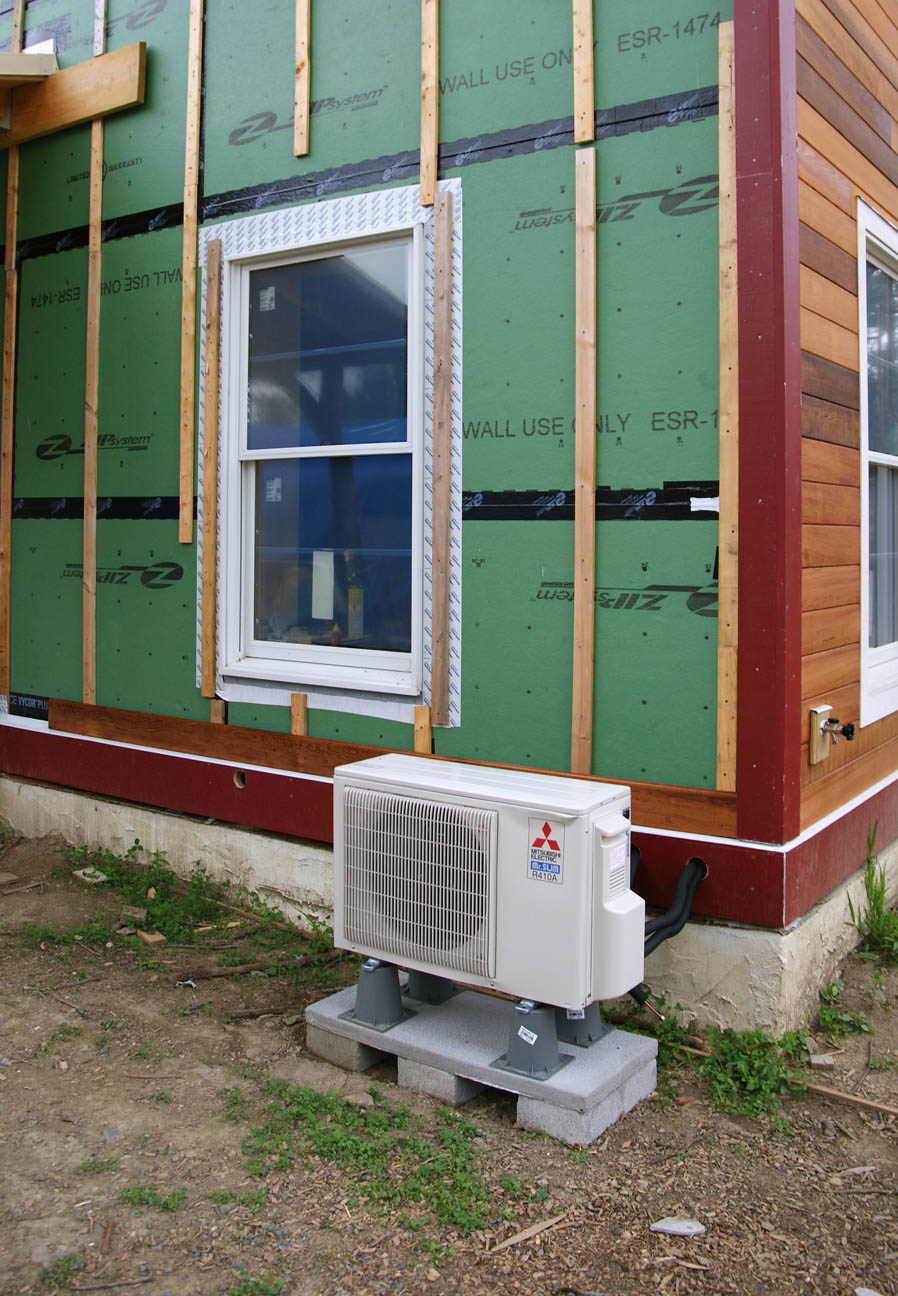
The compressor part of the Mitsubishi Mr. Slim minisplit.

The compressor part of the Mitsubishi minisplit. This is lower to the ground than I would have liked. We will need to make sure snow doesn't build up around it. Eventually I will build a little roof over it. It is stood off from the house by about a foot and half so the fan can properly blow the cold or heat off of the radiator.

If you are from New England, or other cooler locations of the world, you might be asking “Why haven’t I heard about this technology?” The reason for this is, generally, these units only put out around a quarter of the heat a typical New England house would need. Of course, with our double stud walls, and plenty of foundation and roof insulation we only need about a quarter of the heat of a typical house.

Another frequent question is “How will the upstairs be heated if the heat is only coming from one spot on the first floor?”
I agree this is a concern, but my understanding is that the heat will distribute itself through the house faster than it can escape through our super-insulated shell. To assist in the distribution we have an open floor plan on the first floor, as well as an over-sized stairwell opening. All this being said, I still have some concern around the upstairs and third floor room being cool, which is why I had Hubbard Heating and Cooling install a second refrigerant line-set that goes to the master bedroom. This way, if it ends up being to cool upstairs, all we have to do us plug in an additional air source heat pump.

Mike Hubbard can be reached at 413-498-2970, he operates out of Northfield Massachusetts

Roof system change

A couple of weeks ago, after talking with my insulator, I discovered we had a serious mis-communication forcing us to radically switch the design of the roof system. The original plan was to have an un-vented roof system with 32″ of dense pack cellulose (4 pounds per cubic foot) filling the parallel chord trusses. My understanding is that there was nothing intrinsically wrong with this approach. The cellulose would stop any air movement that might carry moisture to the colder exterior part of the roof system. However, I have since learned that it is virtually impossible to dense pack such a huge thickness. Furthermore, the added weight on the trusses was not factored into their design.

The new plan is to vent the roof by:
  • Creating an airspace underneath the sheathing by installing Typar on the underside of the top chord of the truss.
  • Installing one 4″ circular soffit vent per bay
  • Cutting holes in the wall sheathing where it meets the roof sheathing, install screen to prevent pest entry
  • Cutting holes in the lookouts where they pass through the interior bay so those bays can vent all the way up
  • Removing the ridge cap, cutting a slot for the air to escape through the ridge, replace the ridge cap with Coravent (a thick bug-screen material)
  • Switch from having the sheathing be the air barrier to having the interior ceiling plane be the air barrier. This will mean using a combination of sealing the drywall to the framing, and using Tu-Tuf cross laced polyethylene behind the wood ceilings.

Although we will lose some 30 R-value points, the R scale is not a linear one and the decrease has less impact than one might think. As one goes up on the scale each successive R-value insulates less than the previous one. After R-80 there is very little payback. So, from an insulation point of view, we were going to pay for about $800 worth of cellulose that wouldn’t benefit us except to make dense pack system work.

The new roof system will have 24″ of cellulose blown in at 3 pounds per cubic foot for what will be around R-85. Since this lighter pack of cellulose can’t be relied upon to block air flow through it we will need to install a an air and vapor barrier underneath the cellulose.
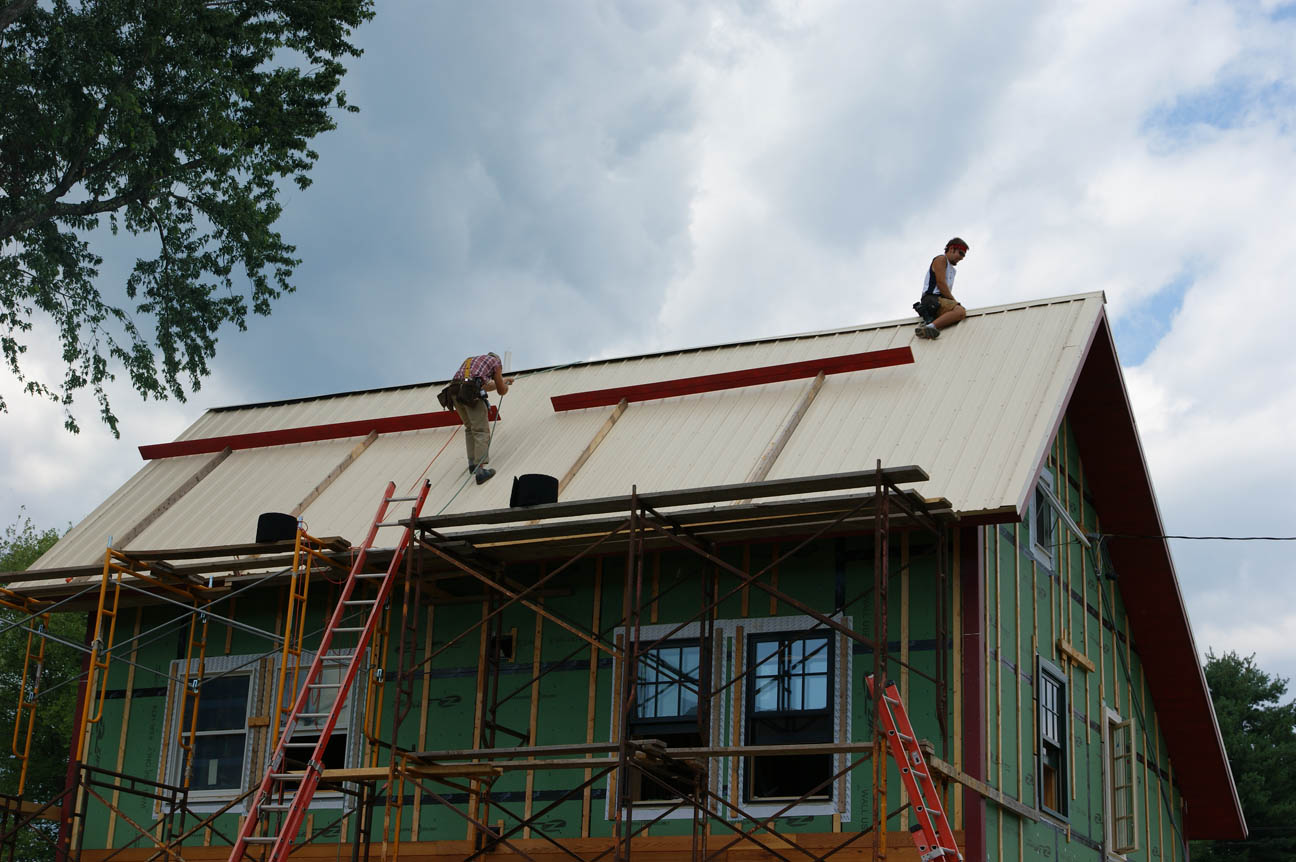
Adam and I have been dreading doing the ridge cap work for obvious reasons. Over the past two days we got it done–in large part prompted by the arrival of our solar hot water panels. Adam, as he put it, doesn’t remark about the difficulty of work; not so this time. Thank you Adam!

Removing and working on the ridge cap

Here we are just starting the removal process: unscrewing the ridge cap. The red boards near the ridge are a shelf that the cap rested on while we worked on cutting open the ridge and laying the Coravent. Although slow, we found that a sawzall was the best tool for the job.

Ductwork

Throughout the last week I have been plugging away at the duct work for the HRV (Heat recovery ventilator). For those who don’t know, a HRV is a ventilation device that passes stale exhaust air from the house by fresh exterior air thus exchanging the heat from the exhaust to the fresh air. Best practices call for exhaust registers to be in the bathrooms and kitchen, while supply registers to be in the living spaces and bedrooms. When installing the exterior vent shrouds, one should place them at least 6′ apart so the two air flows don’t mix. Also, the shrouds should be on the same side of the house to avoid differential between air pressures.

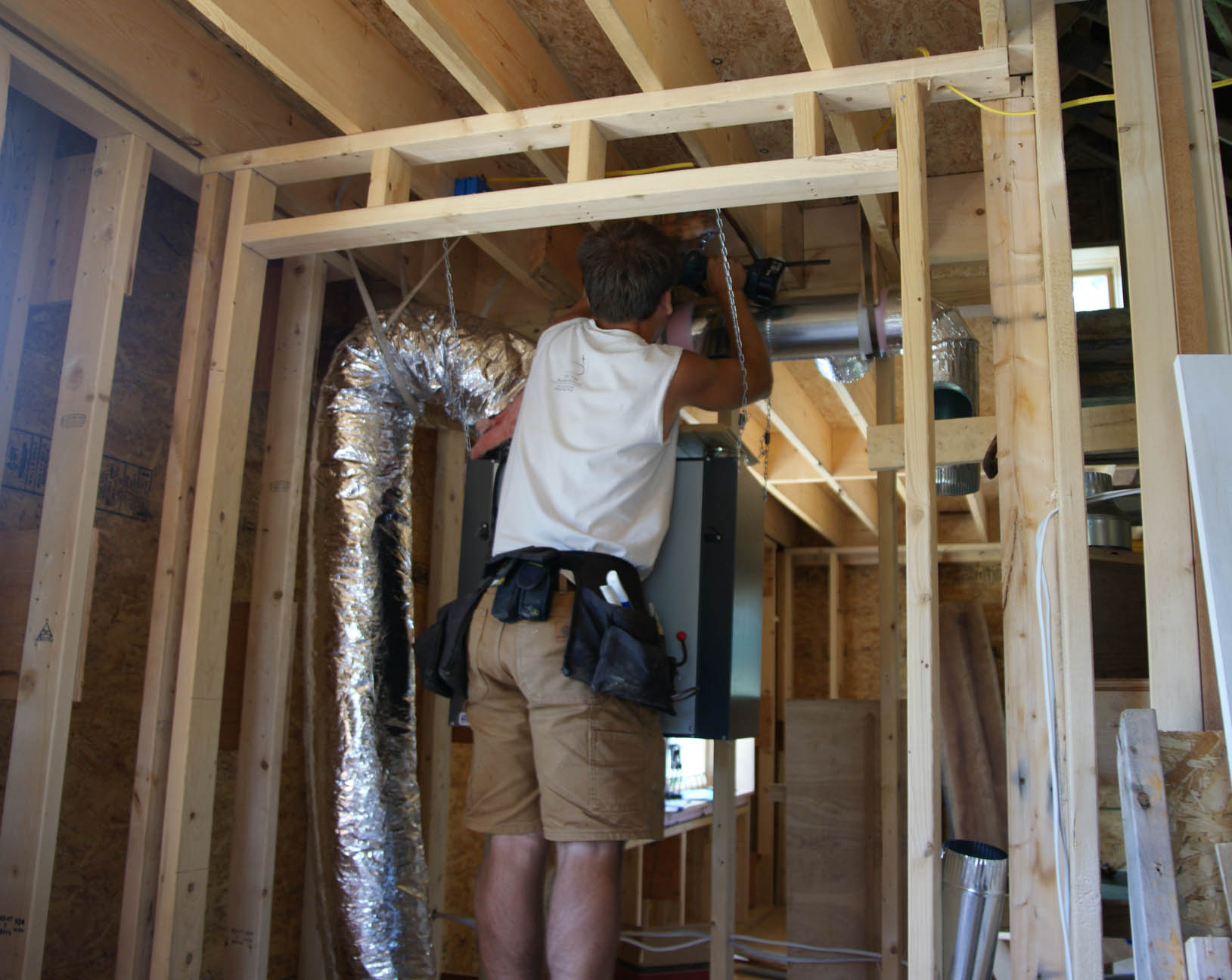
For the ducts I have been running 6″ round main lines with 4″ round branches. For an HRV we are using a Venmar EKO 1.5 which runs on a very efficient 24 watt ECM motor while transferring 80% of the outgoing heat to the incoming air. In order to boost its efficiency I located the unit on the south side of the house where the exterior air will be warmer. The downside of this is that the HRV is in the master bedroom closet taking up most of the space.

HRV installation

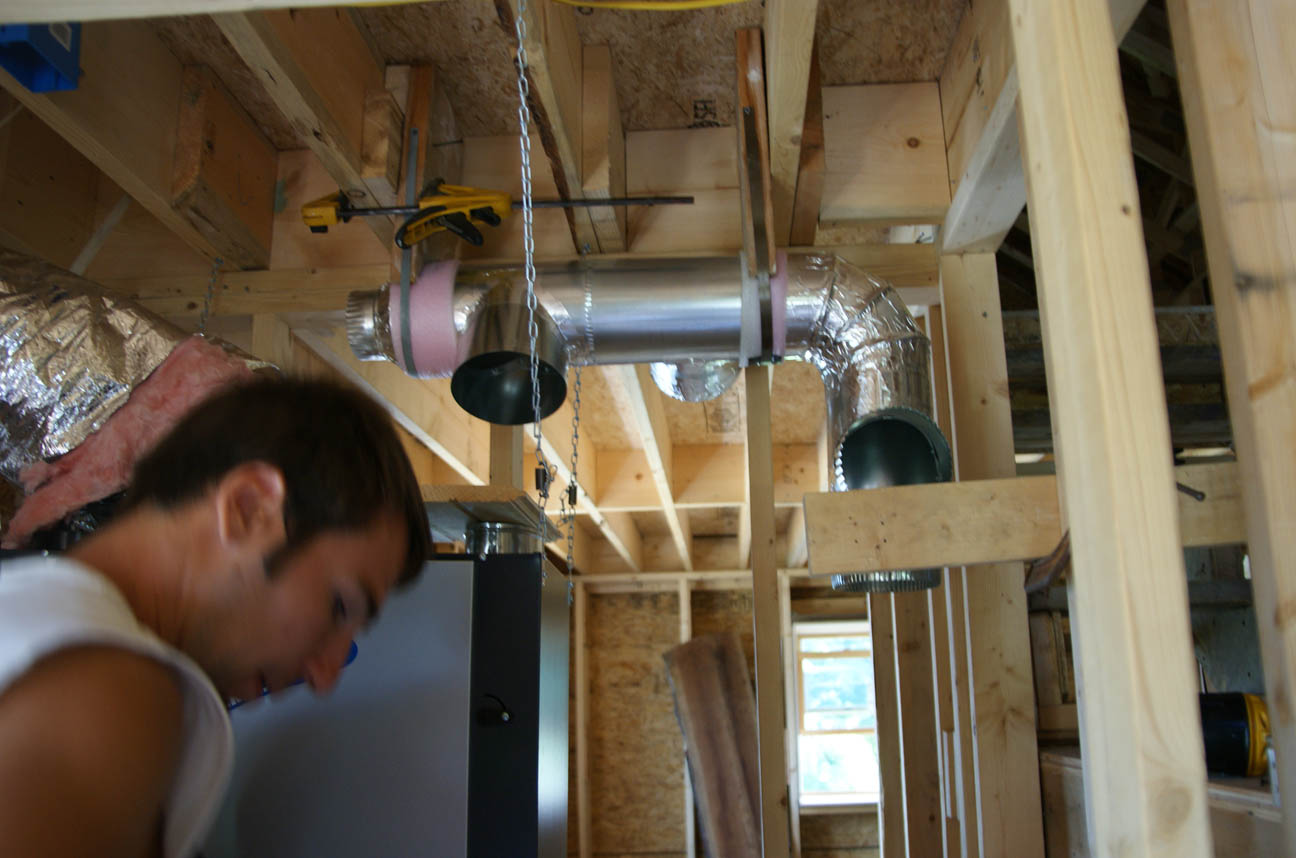
The installation for the Venmar EKO 1.5 calls for it to be hung from joists by chains that have springs on them to mitigate the amount of noise it transmits. On the left side of the picture you can see insulated flex duct. The ducts that go to and from the HRV and the exterior need to be insulated to prevent condensation on them. One thing I didn’t like about the EKO 1.5 is that all four ports are on the top. Most HRV’s have two ports on opposite sides. Having all the ports on the top means they get in each others way. Also, if you are like me, and decide to install the unit on a second floor, you are guaranteed to have to make U-turns in the duct work. Whenever one is trying to move air (or any fluid) through a pipe one tries to avoid sharp bends that restrict flow and can increase noise.

HRV installation

Venmar EKO 1.5 HRV heat recovery ventilator installed

Our Venmar EKO 1.5 HRV heat recovery ventilator installed.

HRV condensate line run into toilet

The HRV produces condensation, which ordinarily is run into a bucket, to the outdoors, or into a drain line. A bucket is work, outdoors meant another penetration in our envelope, and my plumber didn’t think the inspector would allow it to go into the drain. Creativity won out–we ran it into the toilet! A 5/8″ diamond hole saw cut right through the ceramic.


Photos by Hannah

Siding

Hannah’s uncle Andy came to help on July 20th, which was perfect timing because we needed another pair of hands to began the siding process. A big thank you to Andy for helping!  The first order of business was to retrieve the siding from the barn that we had it stored in since last summer (link to post about retrieving the siding). We rented our neighbor’s 21′ trailer for the task (thank you Greg).

Siding arrives at the jobsite

Siding arrives at the jobsite.

Unloading siding

Andy unloading siding.

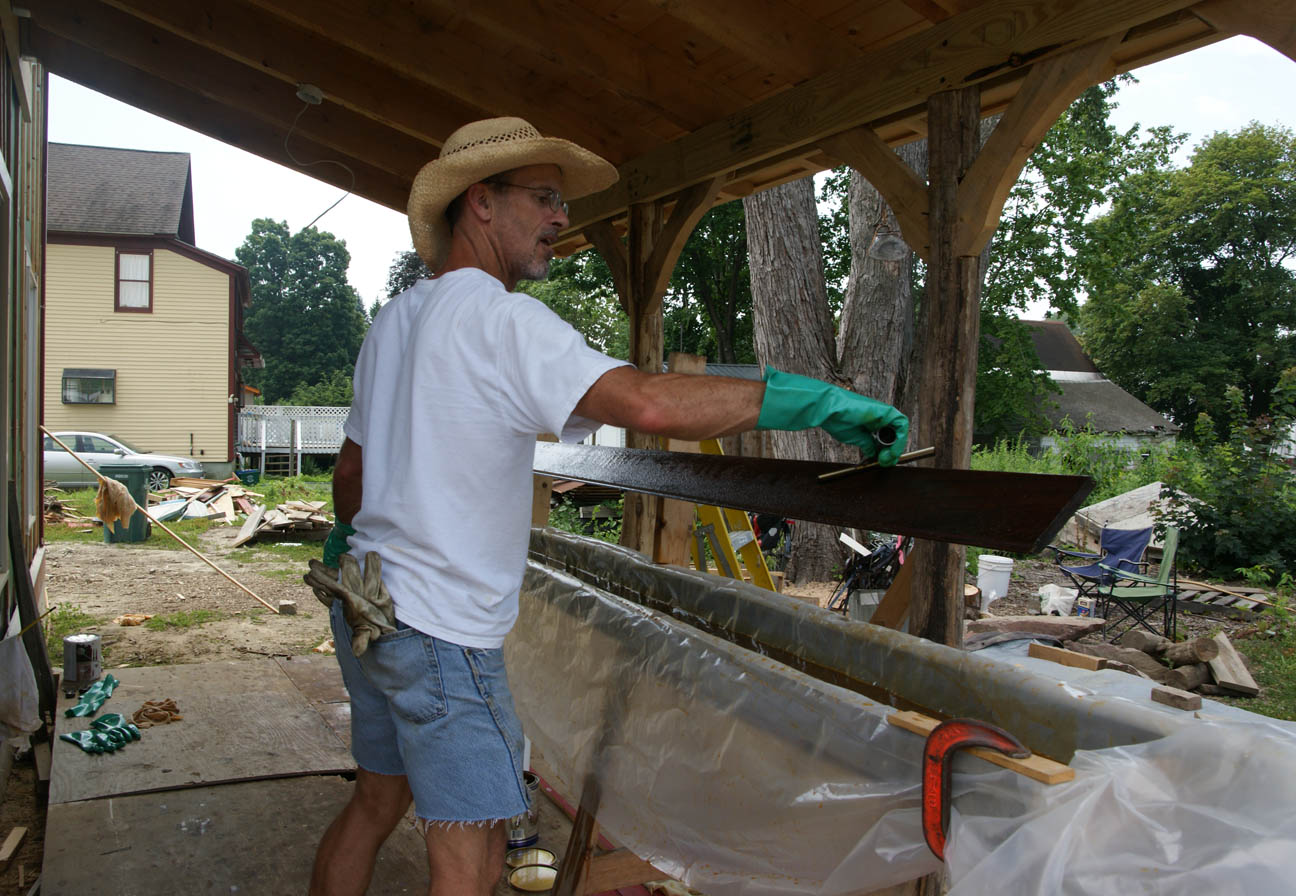
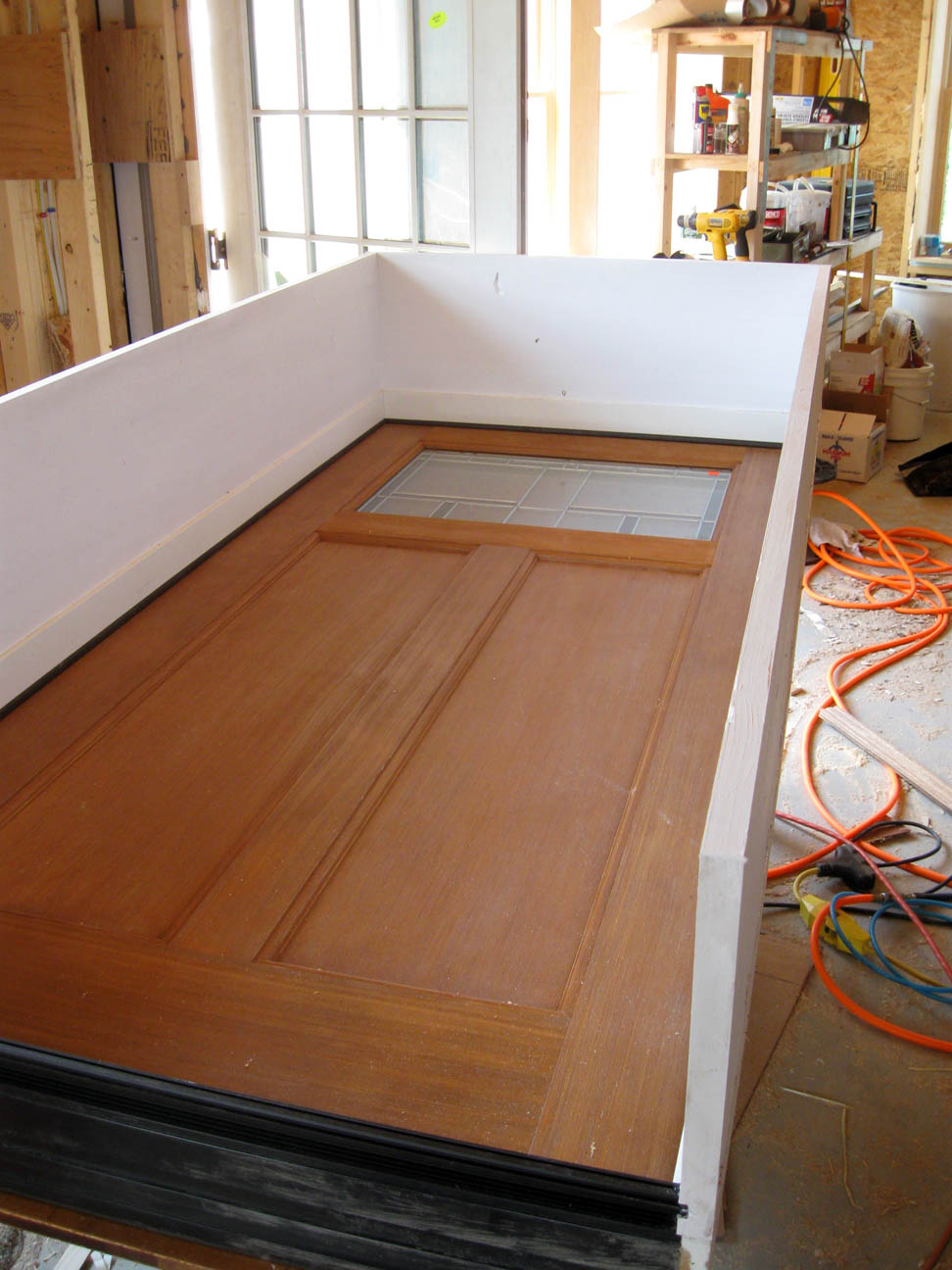
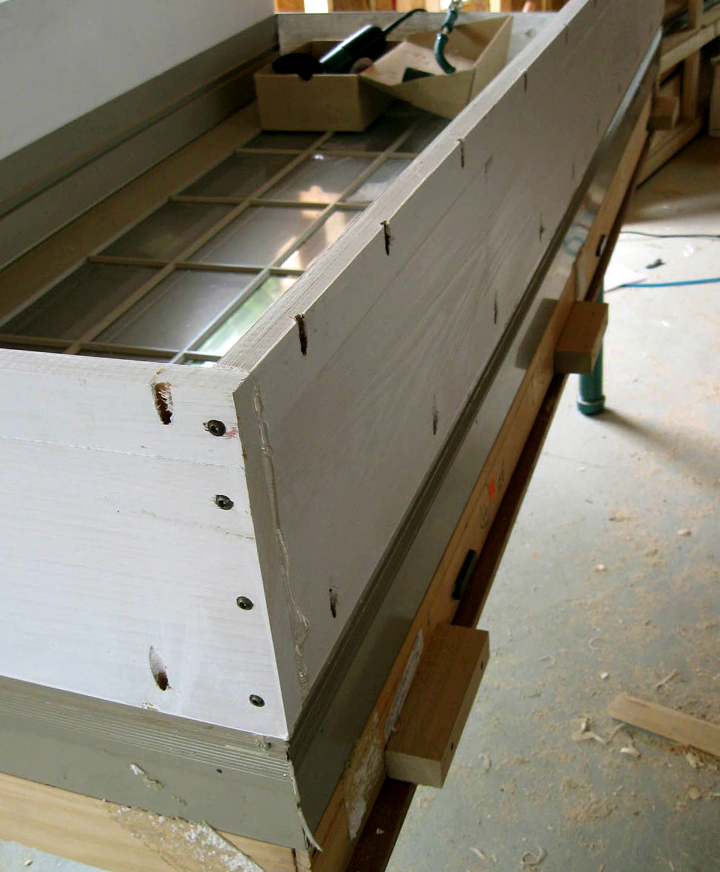
Andy dipping siding board in trough of stain

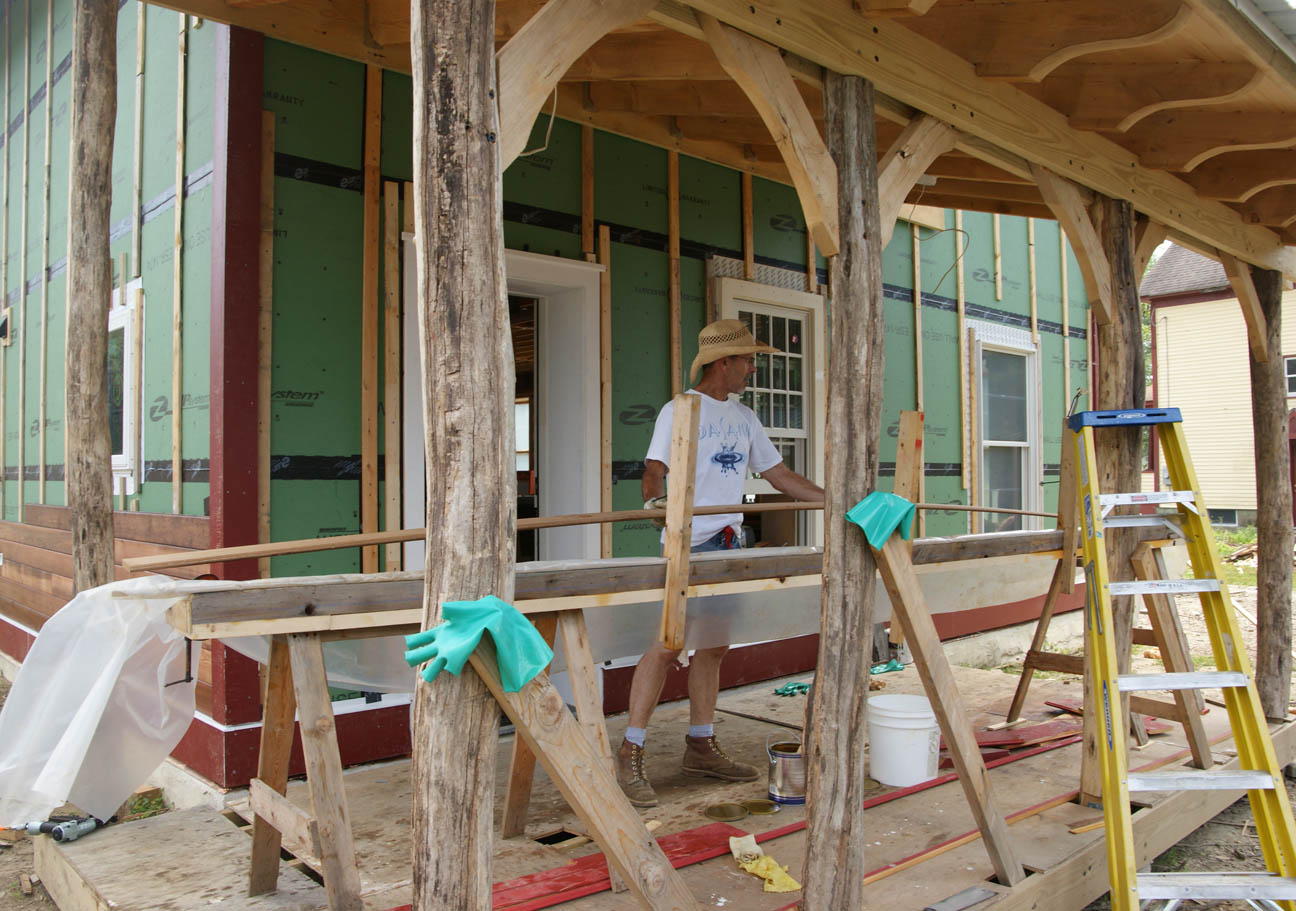
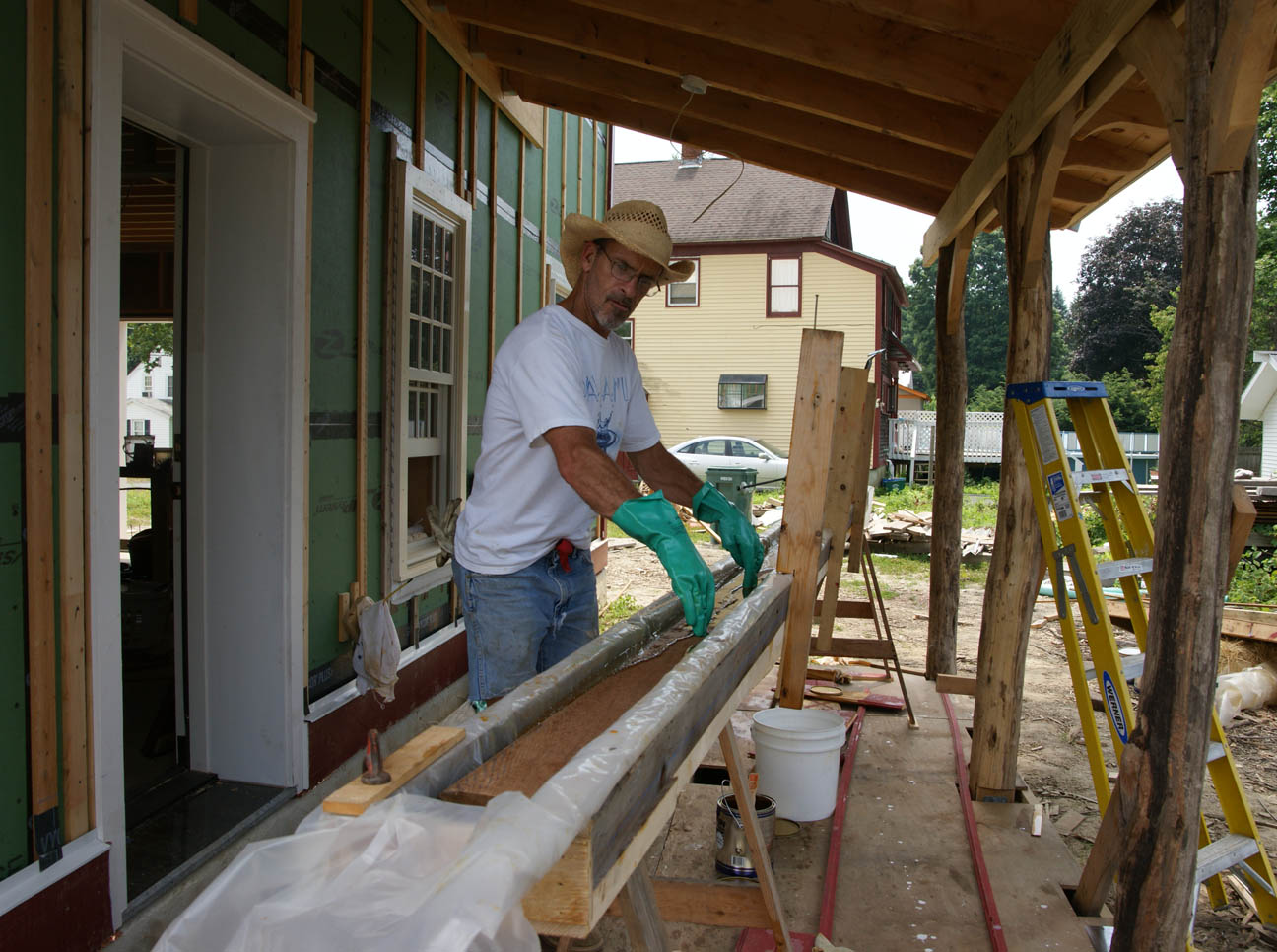
Our first task was to stain the siding with Penofin (a clear stain). Instead of the time-consuming process of brushing on the stain we built a trough to dip the boards in.

Andy dipping red cedar tongue and groove siding board in trough of Penofin stain

Andy dipping siding in trough of Penofin stain.

Wiping off extra stain from the dipped siding with a squee-jee

Wiping off extra stain from the dipped siding with a squee-jee

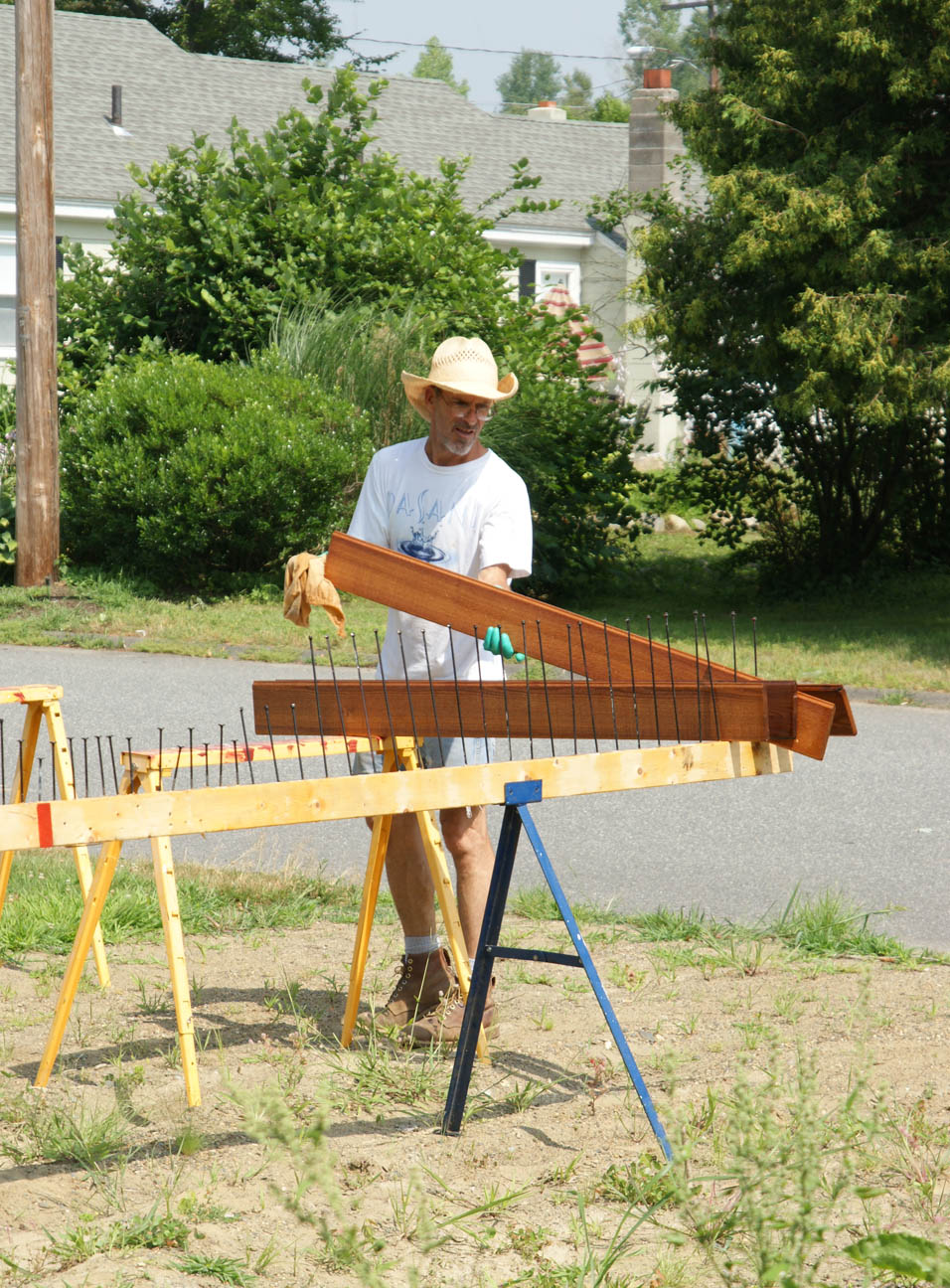
Andy putting freshly stained siding on drying rack

Andy putting freshly stained siding on drying rack

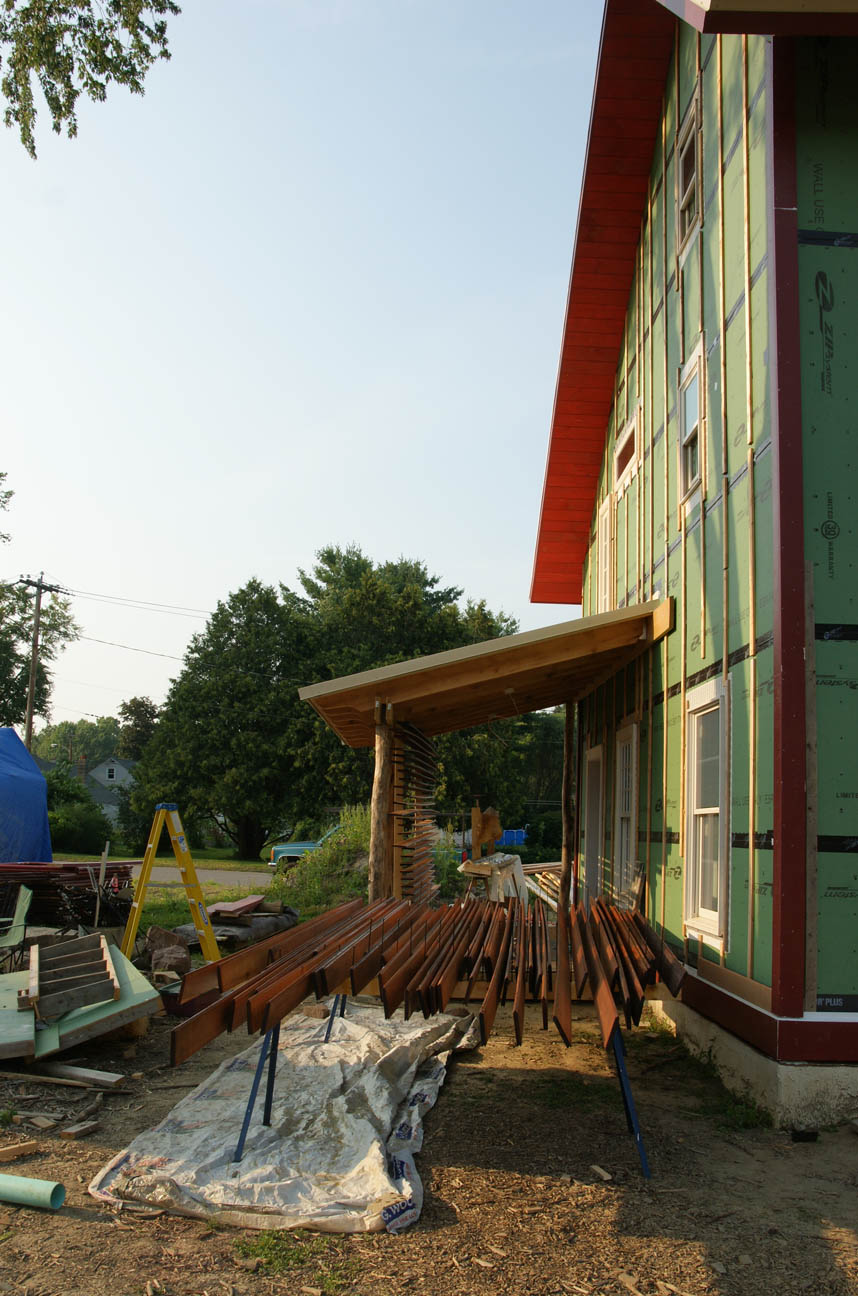
Freshly stained red cedar siding on our drying rack

Freshly stained red cedar siding on our drying rack

July 21st

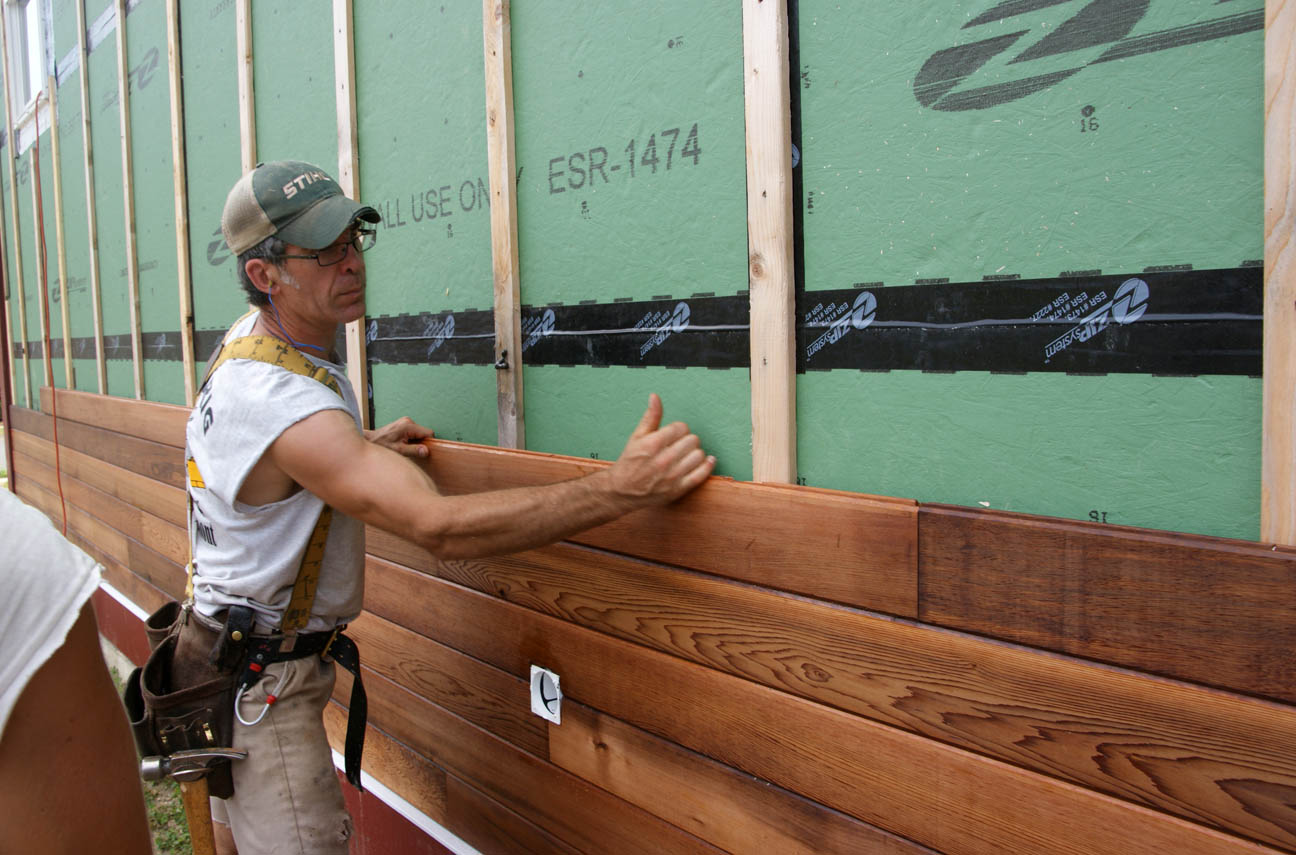
First course of siding goes on!

First course of siding goes on!

Adam installing stained tongue and groove red cedar siding

Adam installing siding

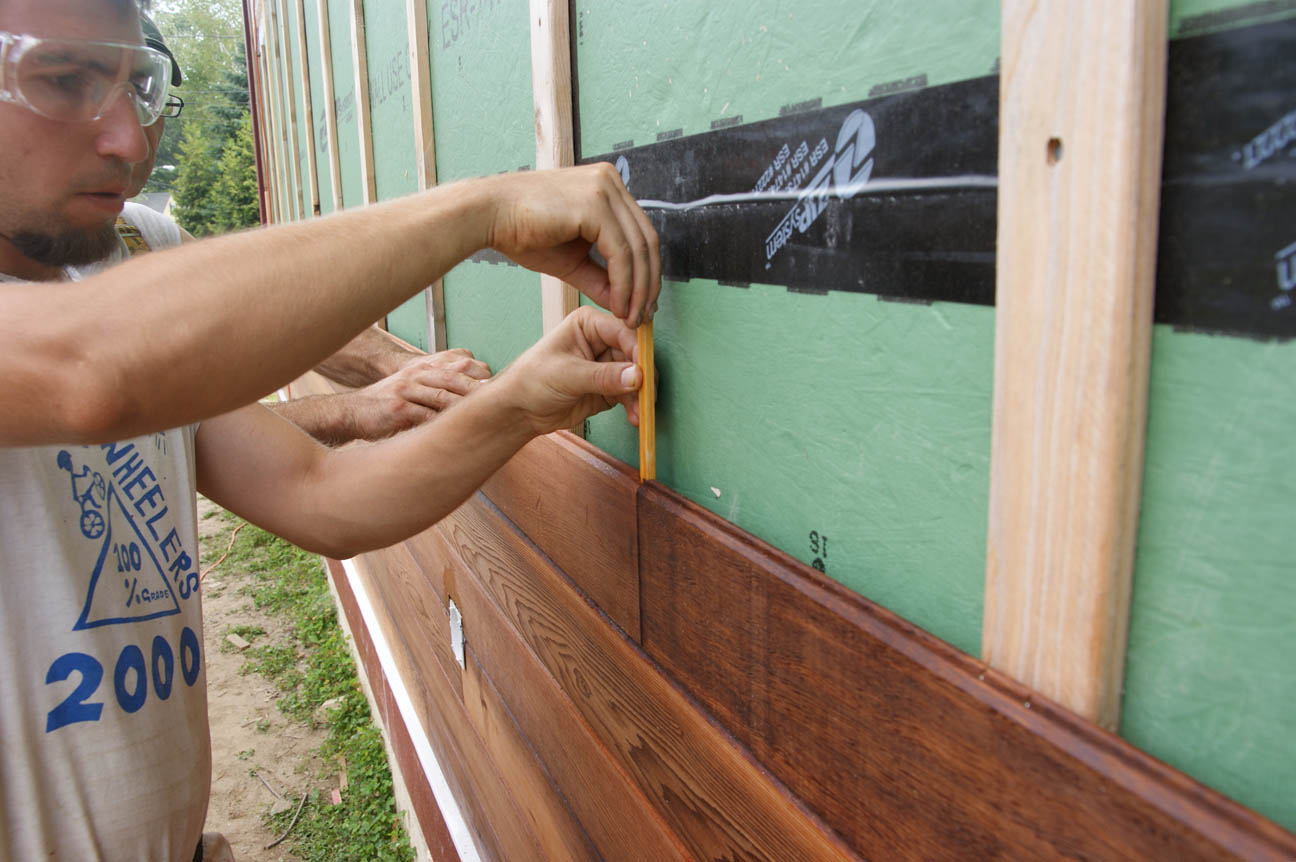
Jig for creating the groove on the butt joint of the siding for the spline to go in.

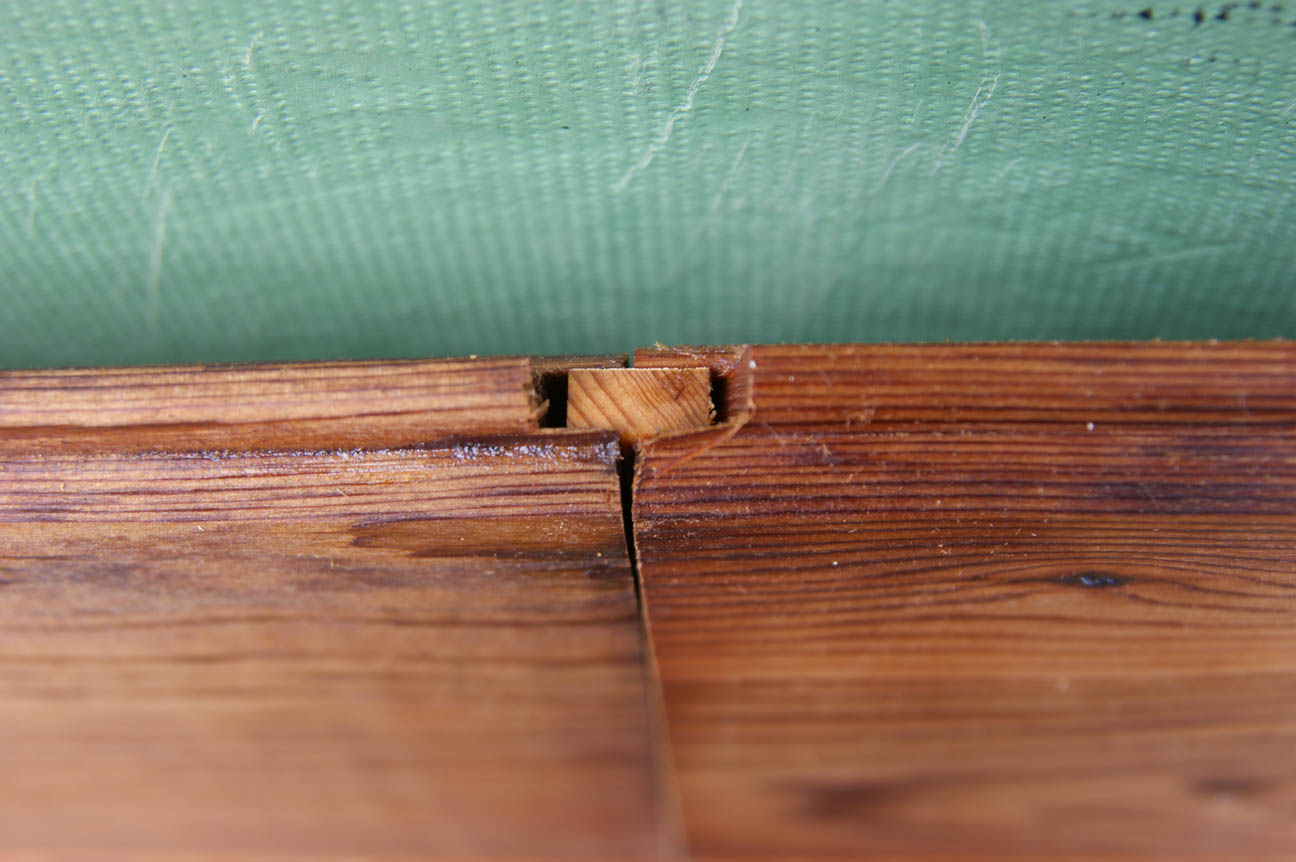
The one weakness in the tongue and groove siding is water infiltration at the butt joint of two boards. With clapboards best practice calls for a scrap piece of tar paper or house wrap* to be installed behind the butt joint. Water that finds its way through the joint encounters a water proof surface that drains it down and out. To solve this issue Adam devised the jig pictured above whereby we would use a router to put a groove on the edge of each board that forms the butt joint. After the two boards are installed we would push in a spline. This sounds time consuming, but the jig made it a snap.                                                                                                                              *Don’t use house wrap in conjunction with cedar, the tannins in cedar ruin the house wrap.

Spartan inserting a spline in the butt joint of the siding

Spartan inserting a spline in the butt joint of the siding

Spline inserted at the butt joint of two tongue and groove red cedar siding boards

Spline inserted at the butt joint of two siding boards

First window trim installed

First window trim installed. We are using stainless steel finish head screws for the task.

July 22nd

Progress with siding the north side of the house

Veronica returns to help with siding.

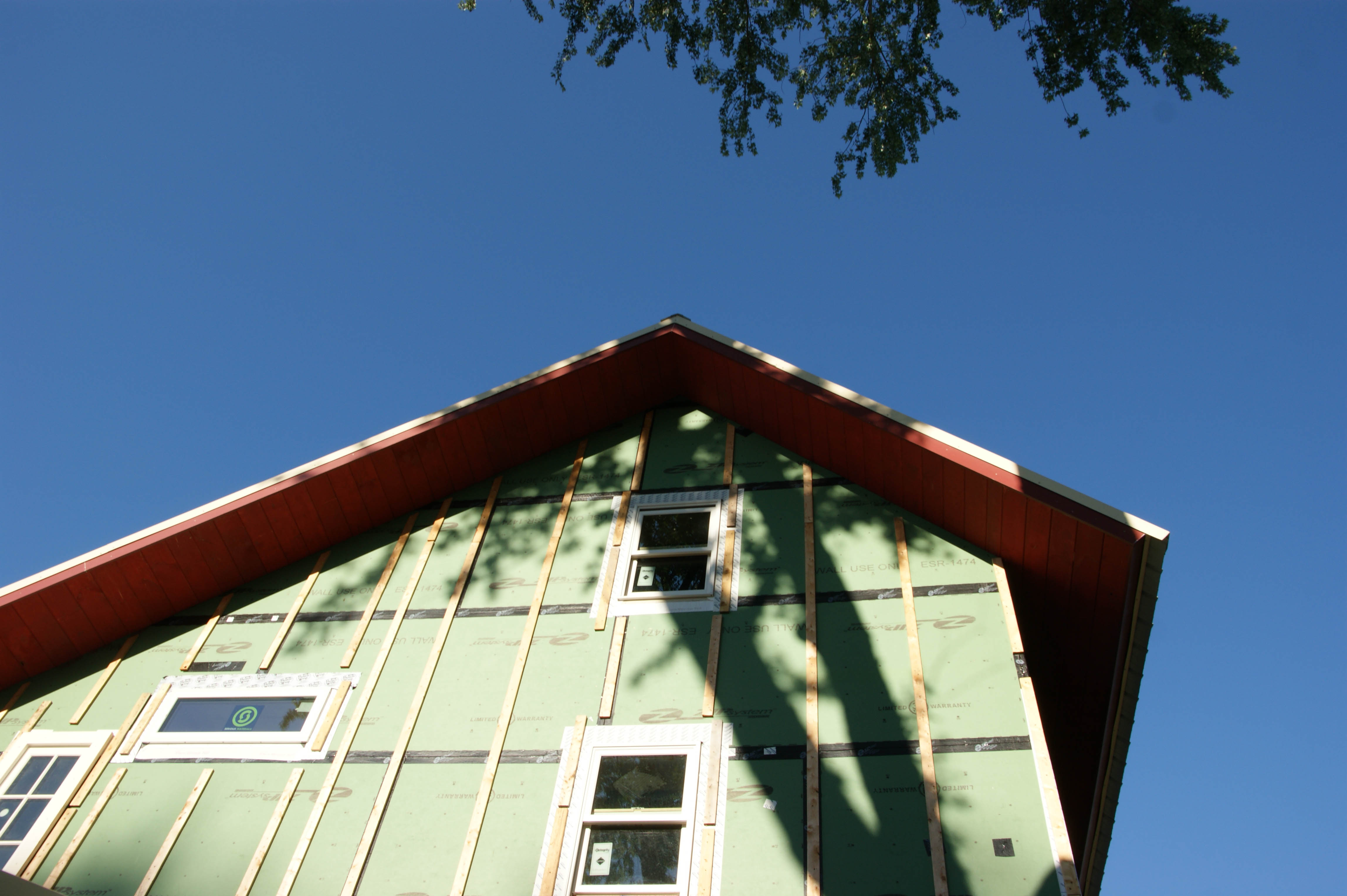
Tongue and groove red cedar siding clear stained on house

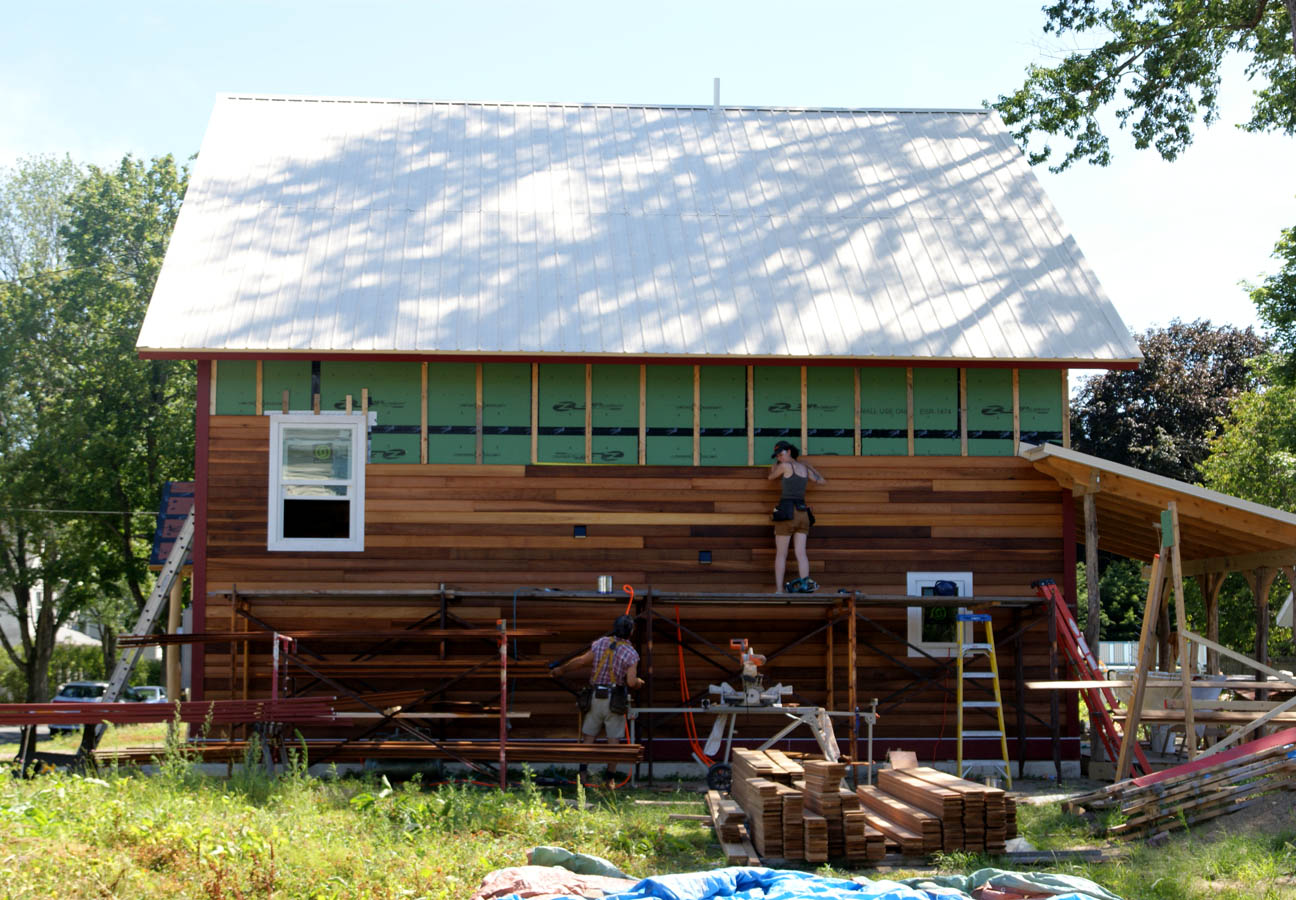
The siding is stunning, especially when the sunset hits it. We have been getting compliments from everyone who walks. There are also a lot of cars that drive by very slowly with passengers craning their necks.

Satellite imagery

Google updated its satellite imagery for Greenfield. The image shows our construction site from late August 2010 when we were working on the foundation. The four sides of the stem wall align perfectly with the four sides of the image rectangle; meaning the house is perfectly aligned with solar south!

First blower door test

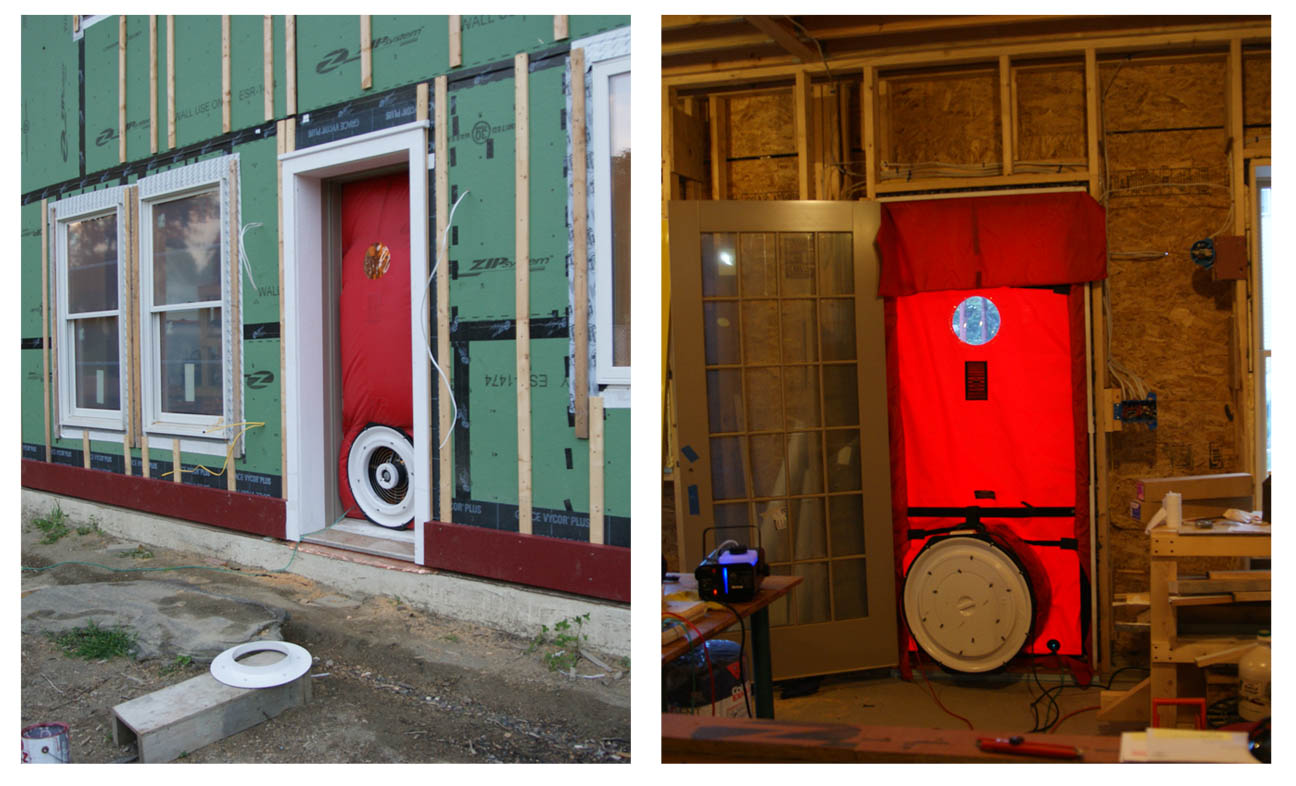
We did our first blower door test on July 18th. A blower door test is a way of measuring how air-tight (or air-leaky) a house is. Basically, you close up the house as tight as you can except for one door. In the door you put a specialized fan that has an airtight shield around it. Hooked up to the fan is are sensors and a computer that, when the fan tries to pull air out of the house, tell you how leaky the house is.

The standard amount of depressurization that is used is 50 pascals (1 pascal is approximately 0.000145 pounds per square inch). At this amount of pressure the fan was able to pull about 137 cfm (cubic feet of air per minute) out of the house. Correct me if I am wrong, another way of putting this is that after one hour of the fan blowing at this pressure, 2/3 of the air in the house would be replaced by new air. This 2/3 number is actually .68 and is called air changes per hour (ACH).

What does this all mean? It means our house is really air tight. So air tight in fact, that out of hundreds of the homes my friend Matt has tested (including new construction), ours is already the most air tight he has ever tested. I say already because not only do I still need to plug up some electrical penetrations and so forth, but we don’t even have insulation or drywall up yet–which will do a lot to prevent air leakage. What is most exciting for me is that we will probably exceed the German Passive Haus standard for air tightness: .61 ACH.

The blower door test setup.

The blower door test setup.

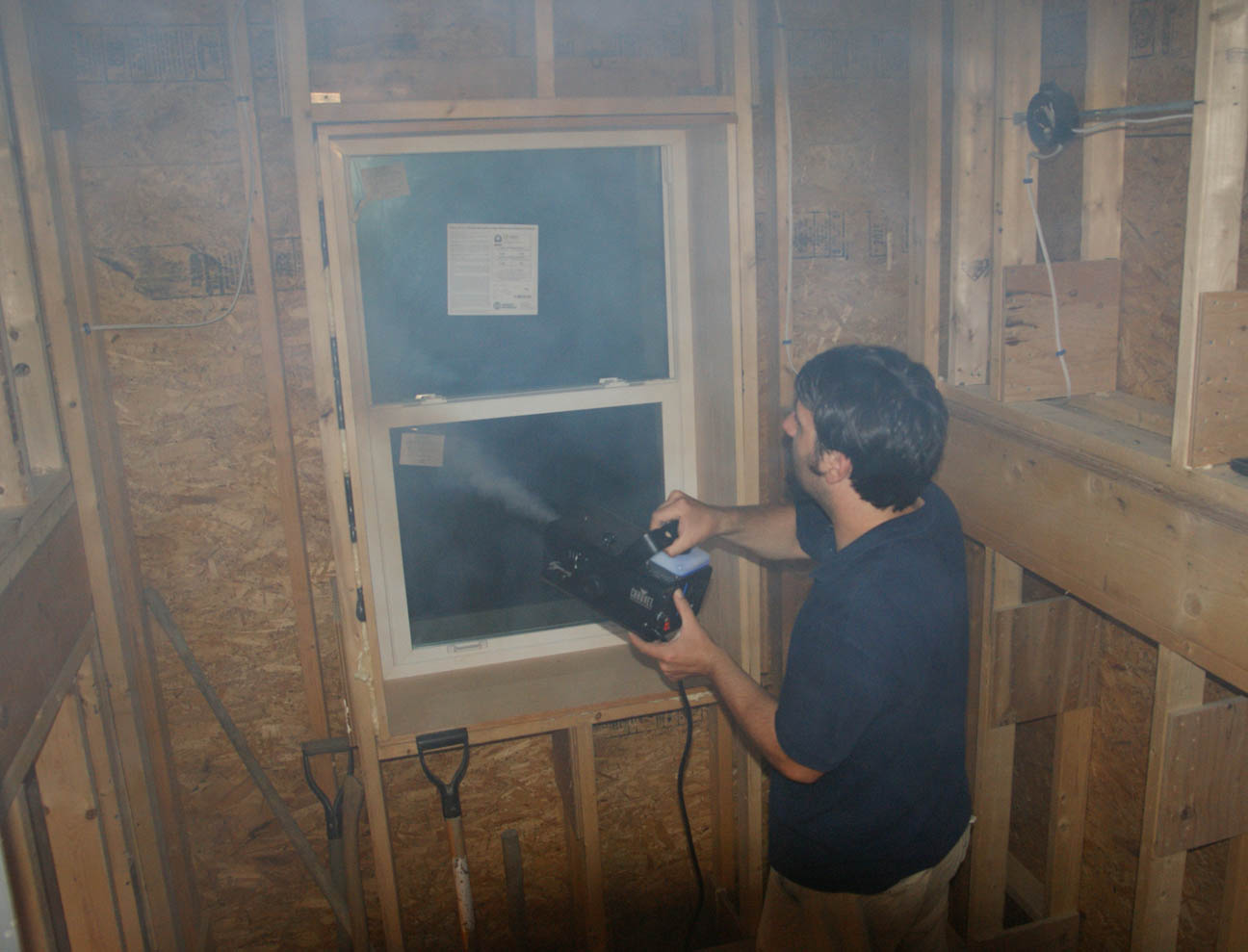
Matt using the fog machine during the blower door test

The blower door test is nice, but actually finding the leaks is better. To do this we flip the fan around so that it blows air into the house. Using a fog machine to make the leaking air visible on the exterior of the house allows you to find where the leaks are. Here, Matt blows fog at a window, a common location for leaks.

Finding where fog is escaping from the house during a blower door test

It was actually fairly difficult to locate where the fog was coming out. Perhaps we needed a more powerful fog machine. I tried using a line laser to see the fog, but it didn't help at all. Later in the evening, I remembered from reading Theodore Gray's graphic book on elements, that gases do not reflect light, they only inhibit its passage. Therefore, shining a handheld laser away from where one is standing would never work. One would have to shine it at one's eyes, which, of course, is dangerous. I then asked Matt's partner Sarah, to shine a flashlight towards me. Sure enough, it did a great job illuminating the fog. If one does see a "gas" reflecting light back at you, like when you are driving through fog, technically you are seeing a vapor or mist.

Thank you to Matt and Sarah for coming up to help with the blower door test.

Exterior doors

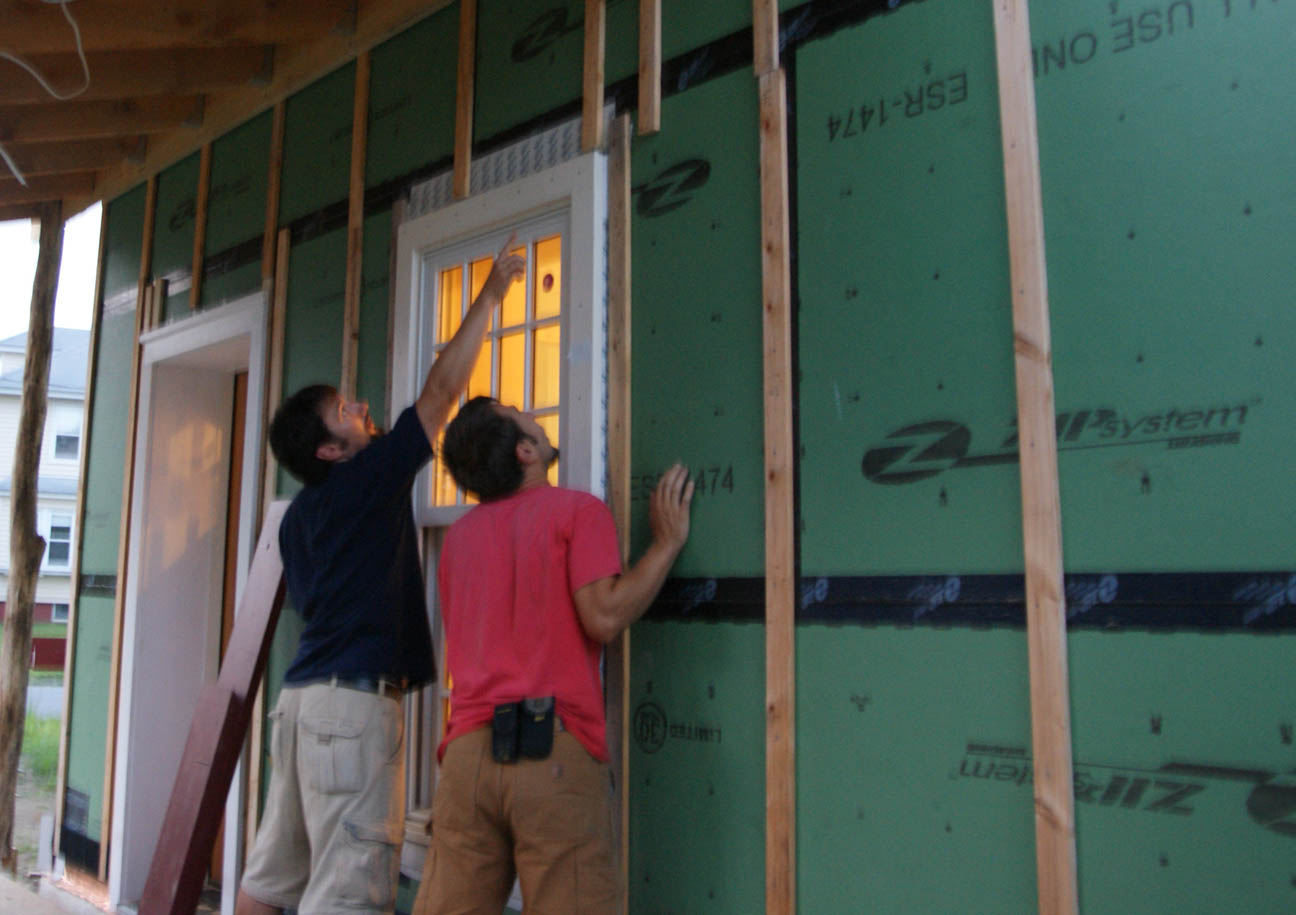
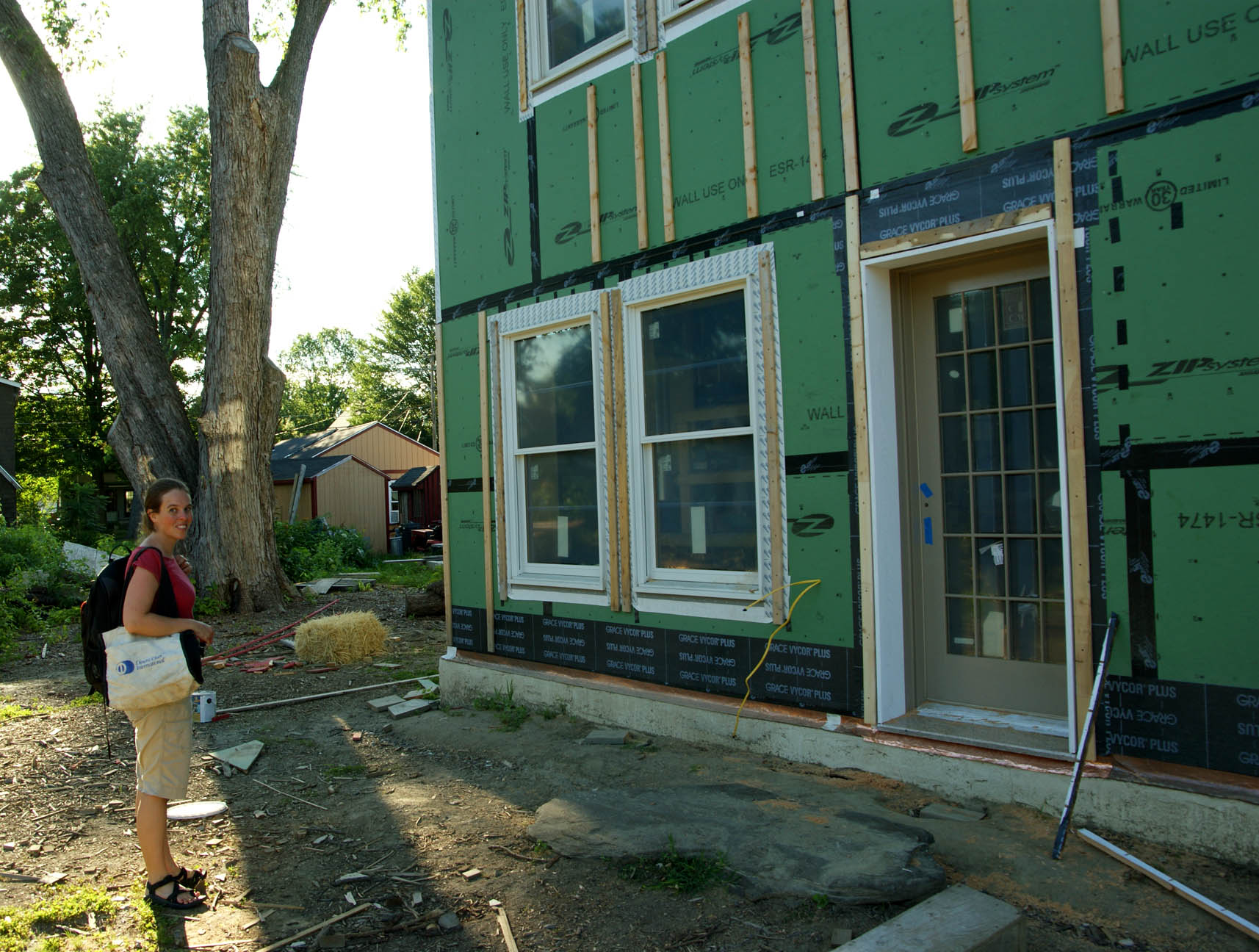
Adam has done fantastic job installing our 3 exterior doors. The job was one of the more complicated ones that we have done. Doors need to be airtight, hang true and plumb, and also be properly flashed to protect them from water.

Installing door jamb extensions

Our exterior door extension jambs put the door flush with the inside of the house so the door can open all the way in. This is the opposite of our window extension jambs, where the windows sit flush with the outside. A quirky way of differentiating this concept is doors are “innie” and windows are “outtie”.

Extension jambs for thick double stud wall use kreg screws

The extension jambs were attached to the aluminum clad door with Kreg screws and water proof glue. There is a second set of screws attaching a strip of wood near the outter edge because the piece of cypress that we used wasn’t wide.
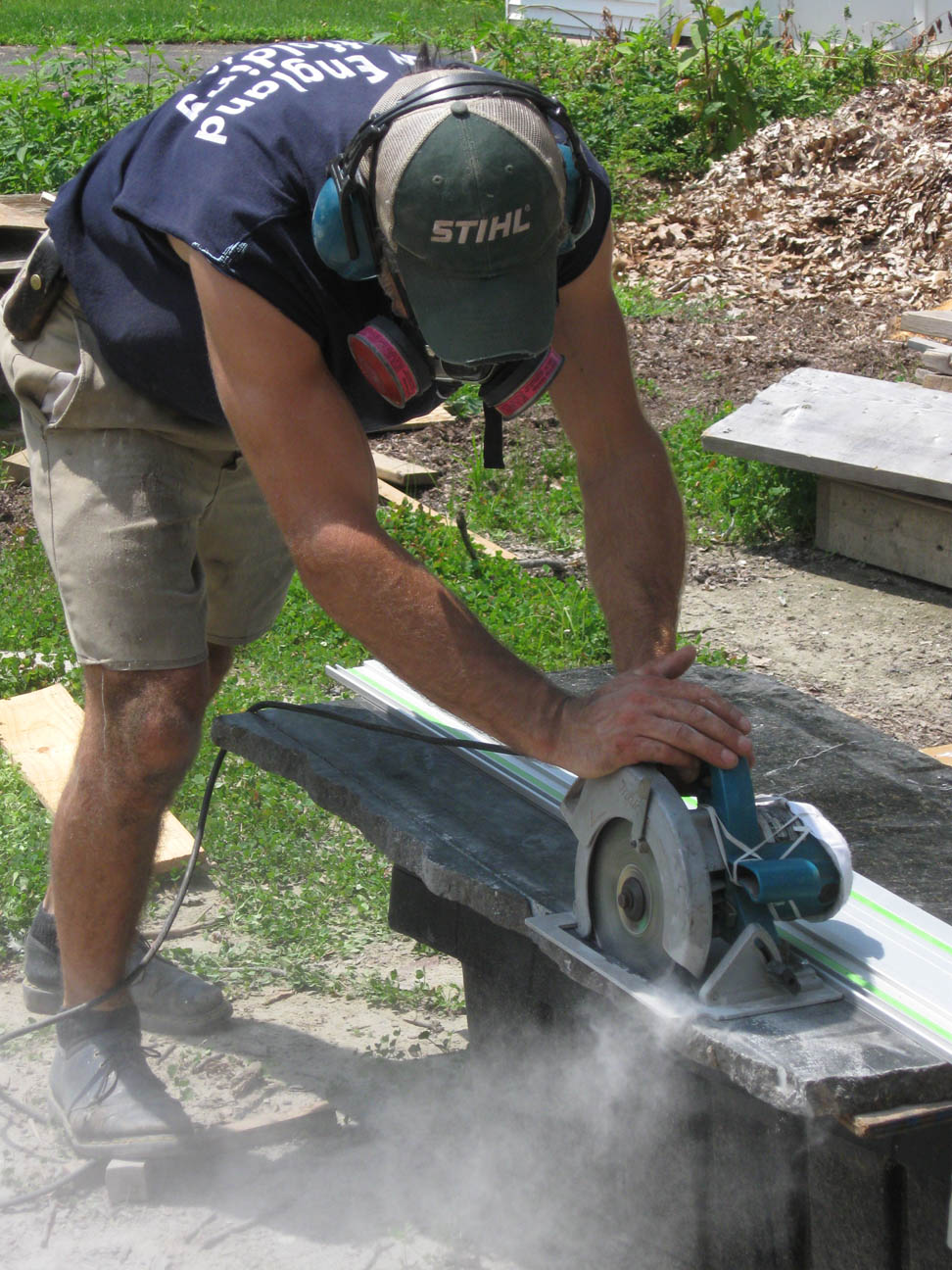
Cutting granite stone threshold - dusty

In addition to extending the jambs of the door we also needed to extend the threshold. We did this using some of our granite counter top scrap. It is amazing what you can cut with a diamond blade on a circular saw. This is easily one of the loudest jobs we have done.

Cutting stone threshold less dust

The stone dust is quite toxic, so we eventually worked out a way to capture most of it with Adam’s Festool shop vac.

Cutting stone threshold close up less dust

The shop vac sucked the dust right up

truck load of granite counter scrap

We needed another large piece of granite for our third stone threshold so we made our second trip to the granite counter top manufacturer to get more scrap.

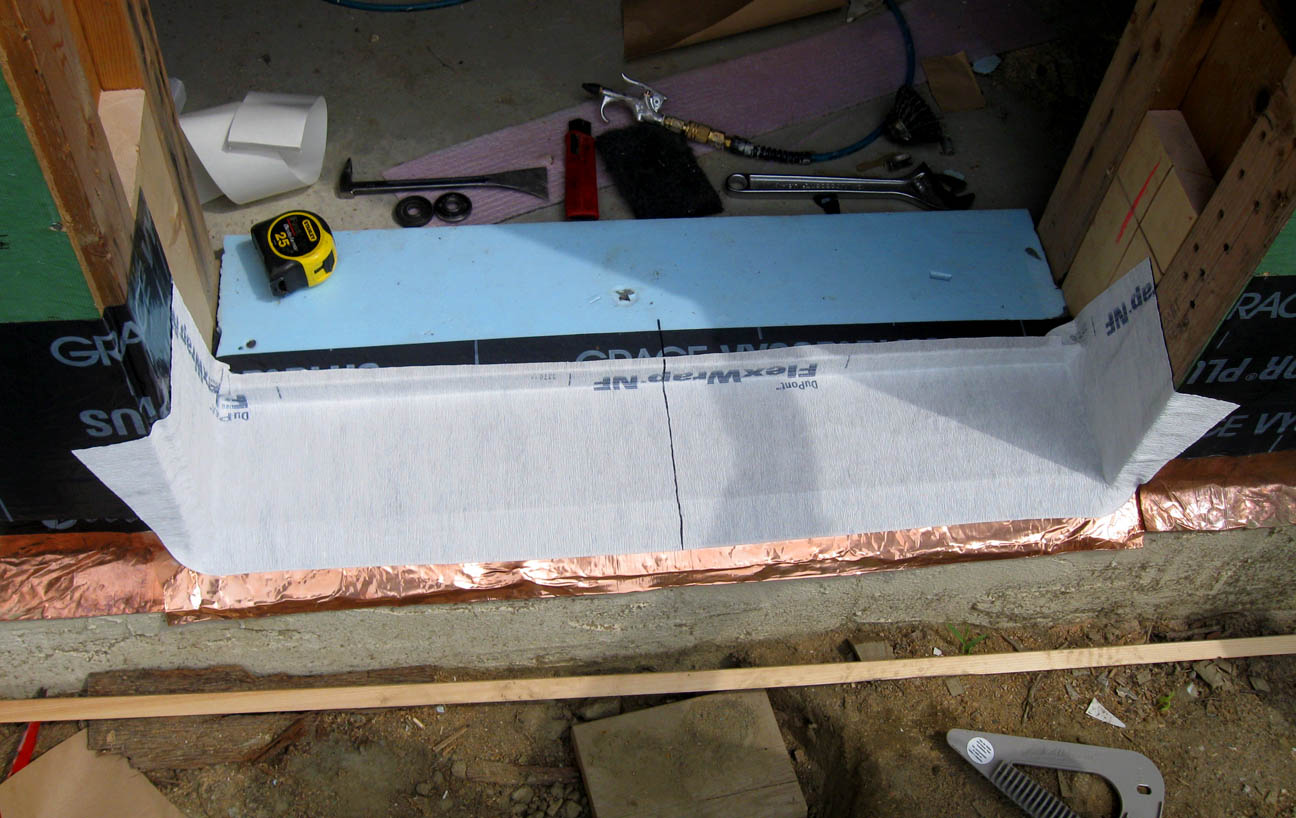
Exterior door sill pan and flashing detail 1

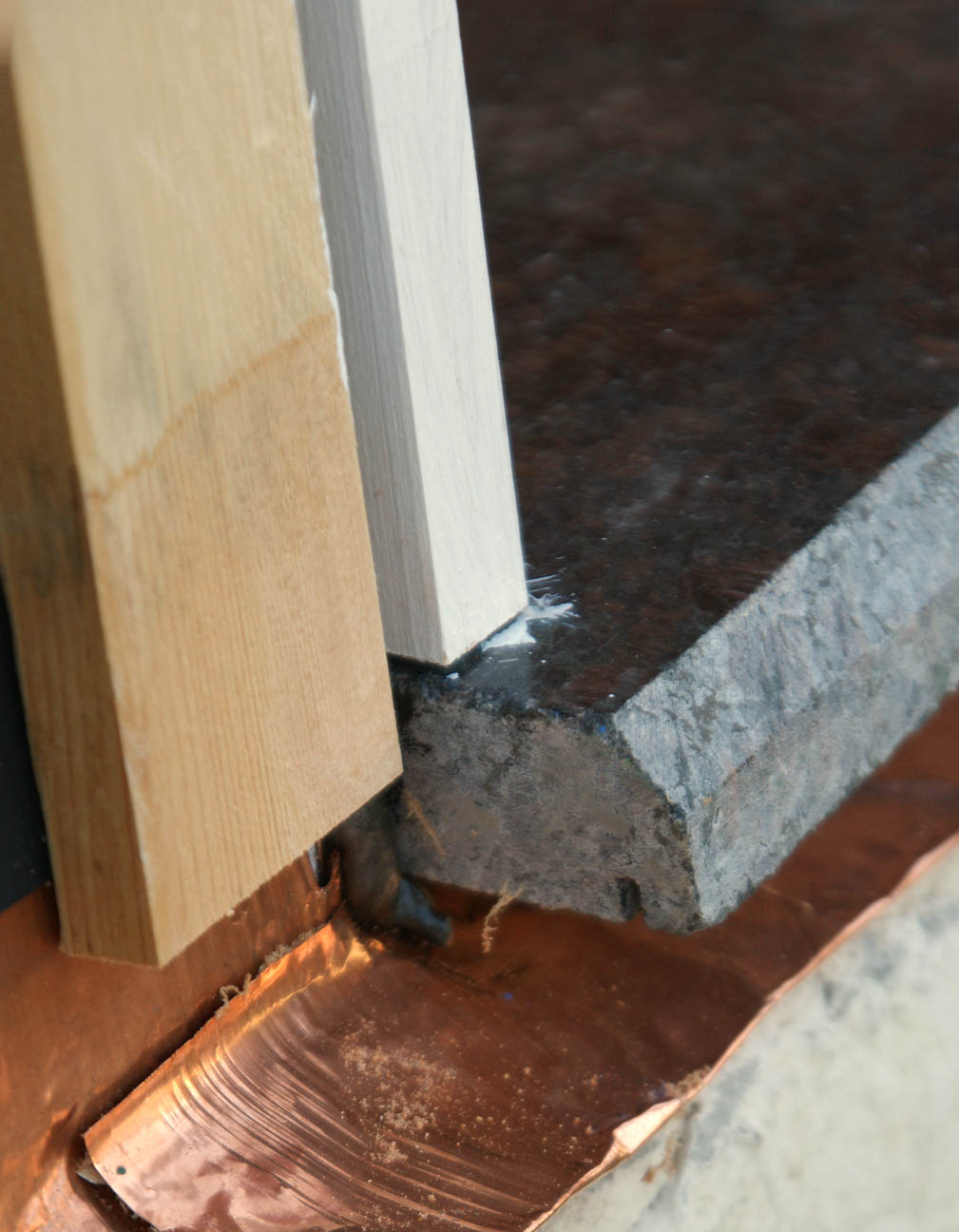
We used flex wrap tape for the stone threshold sill pan (the white area). Behind it is 1.5″ rigid foam insulation that the door will sit on. The foam will eliminate the thermal thermal break under the door. The copper flashing tape provides an impervious surface protecting the parged 2″ of foam that is on the exterior of the foundation.

Exterior door sill pan and flashing detail 2

We used copper for the door sill pan. The stone thresholds look really sharp.

drip edge on stone threshold

Another detail to protect the doors from water. The saw kerf on the underside of the stone threshold is called a drip edge. Water clings to surfaces and can move horizontally along them, however it can’t move vertically (unless you consider capillary action).

Creating a flange for extension jamb by back-flashing with tape

Ordinarily doors and windows have flanges on them that seal them to the sheathing. Since we made our own extension jambs we also needed to make our own flange using a technique called back flashing. One uses two pieces of flashing taped together with about 1″ of overlap. The tape, which now resembles double sided tape, can now stick to both the jamb and the sheathing.

South door

Hannah (with dinner) admiring our southern glass door. I had to put blue tape over the handle and lock set holes because bees immediately started to nest in them.

Installing a door lock

Installing a door lock

simpson bungalow solid fir door with brass thumb latch

Our completed porch door entrance. This is the one that will see most of the foot traffic.

Artistic entry way door under construction

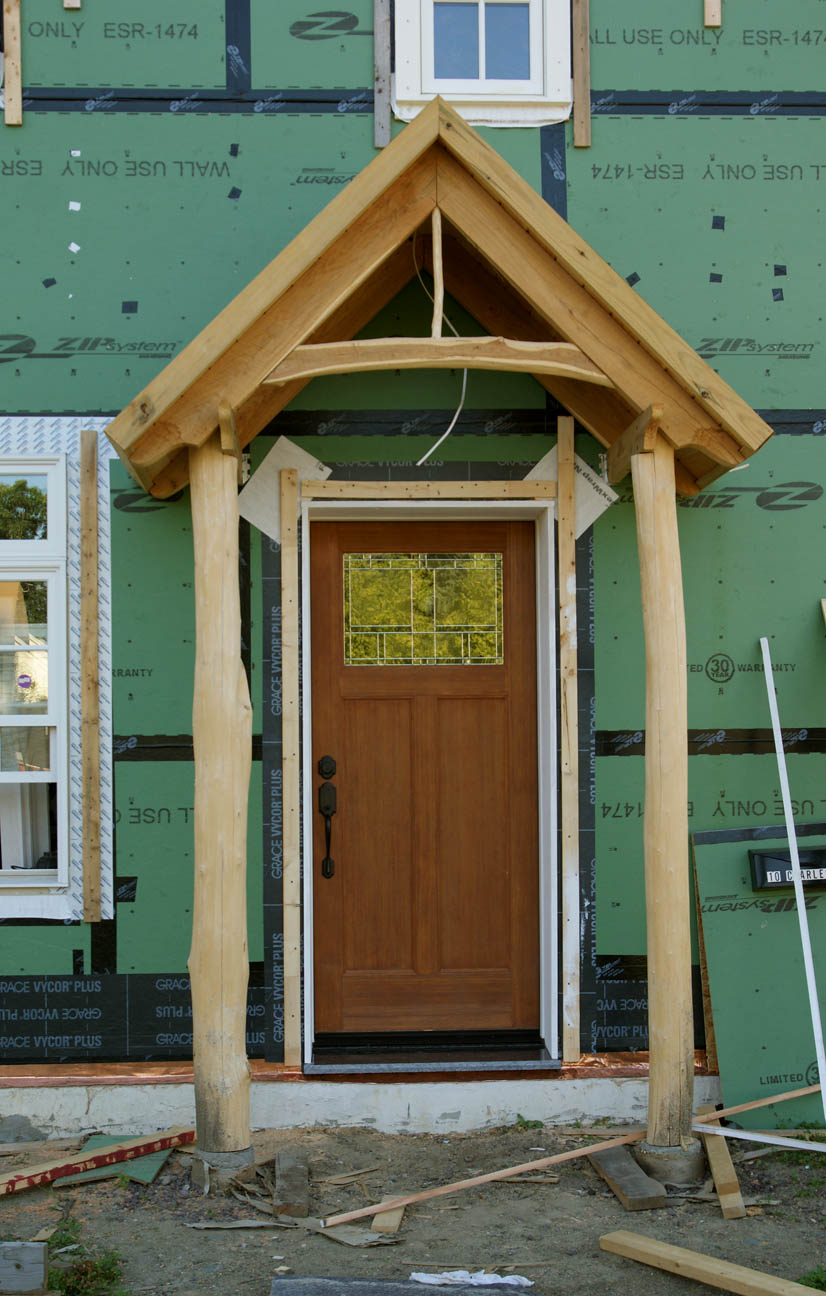
I suspect our Vernon St. door way is going to be in a home magazine some day.

interior of vernon st door

Interior of Vernon St. door.

Soffit complete

Hannah and I went away during the last week of June and we returned to a complete soffit. Adam did a fantastic job putting on the soffit boards that John and I stained.

Tongue and groove soffit boards installed

You may not be able to tell from the picture, but the stained soffit boards are slightly lighter in color than than the painted fascia boards. This was done to compensate for the fact they will always be in shadow.

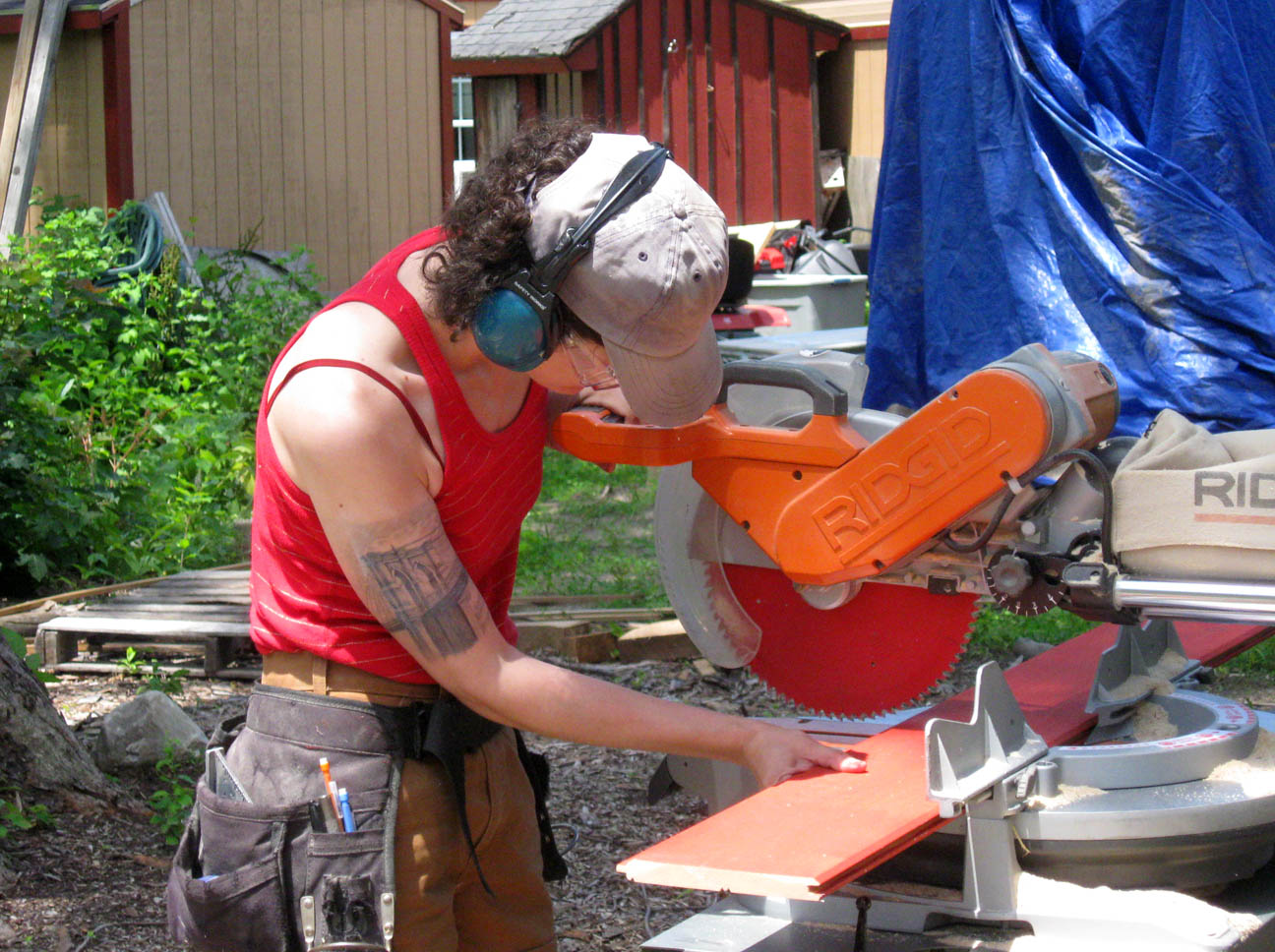
Veronica using sliding mitre saw

Veronica helped Adam out with installing the soffit. She quickly got the hang of the sliding compound mitre saw.