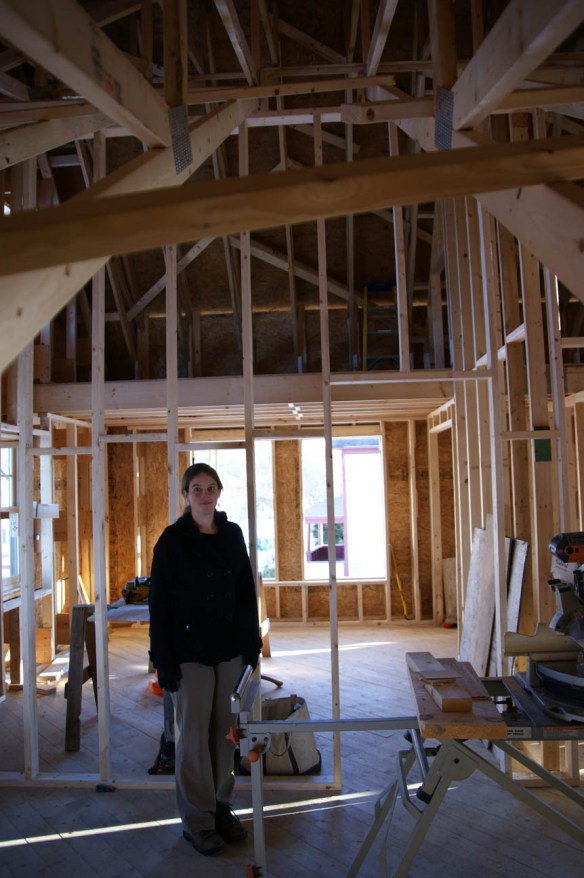
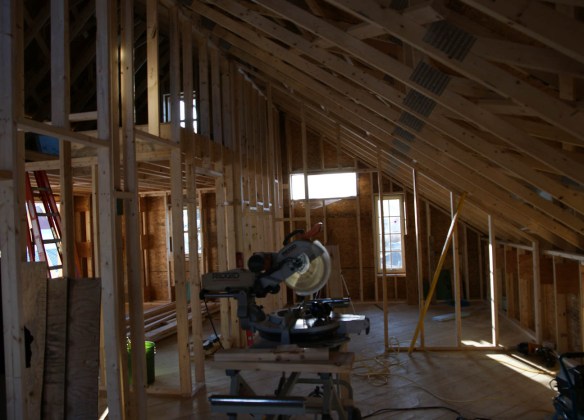
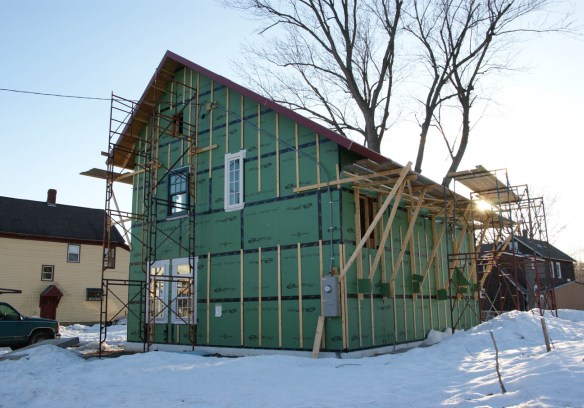
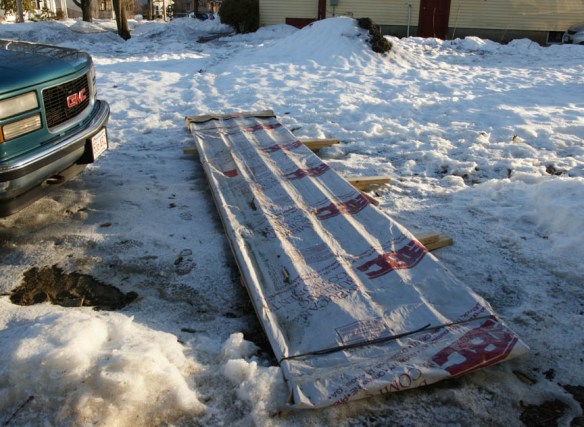
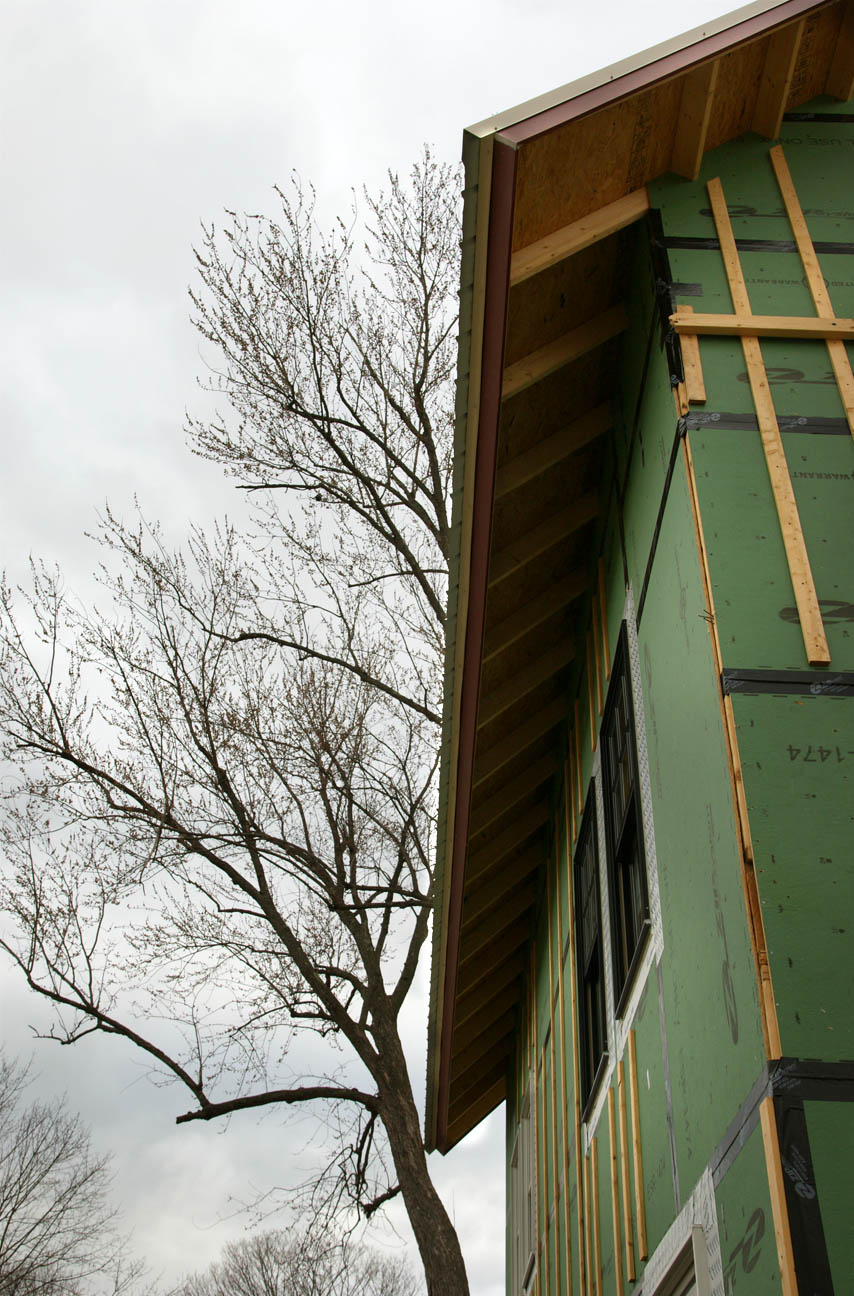
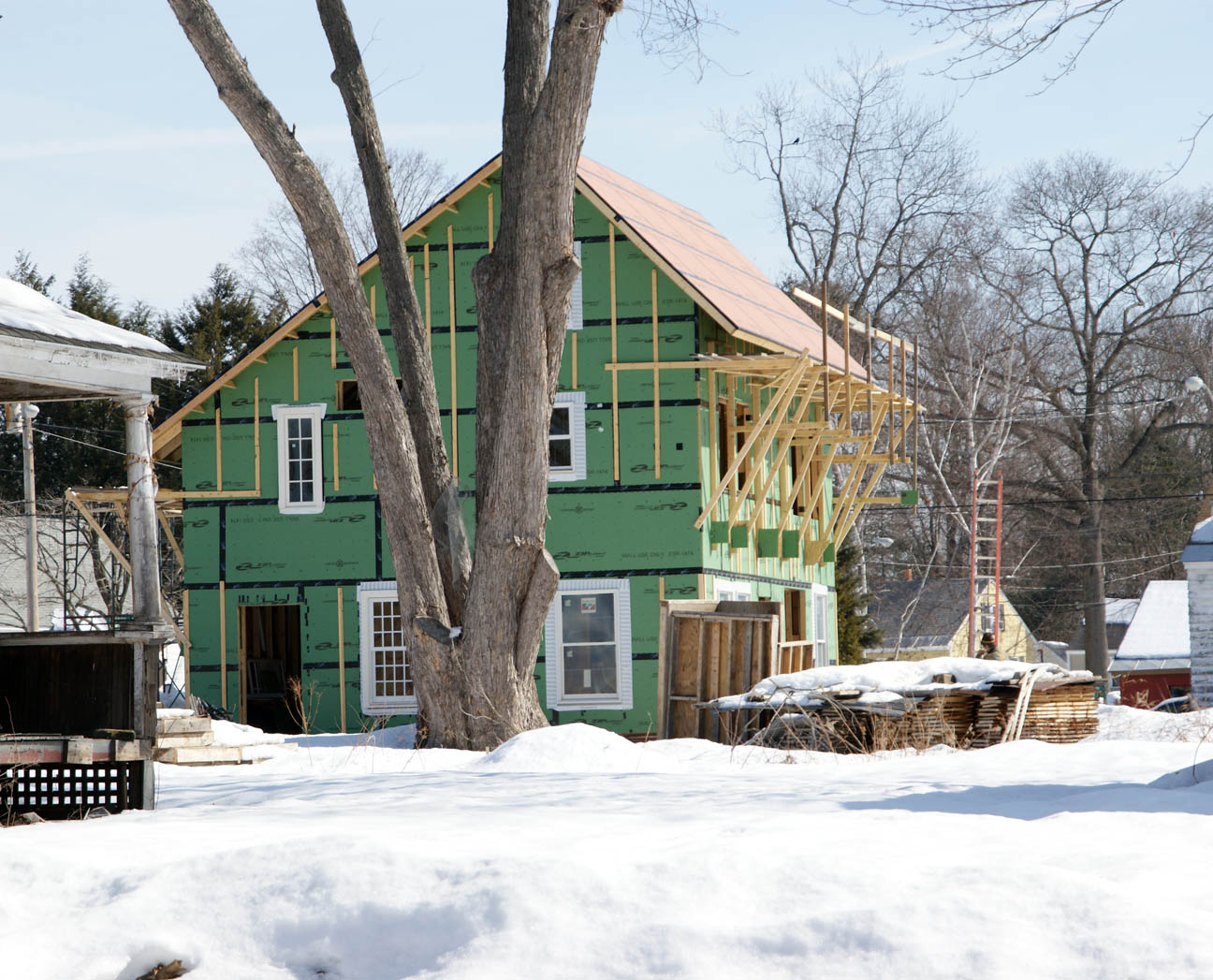
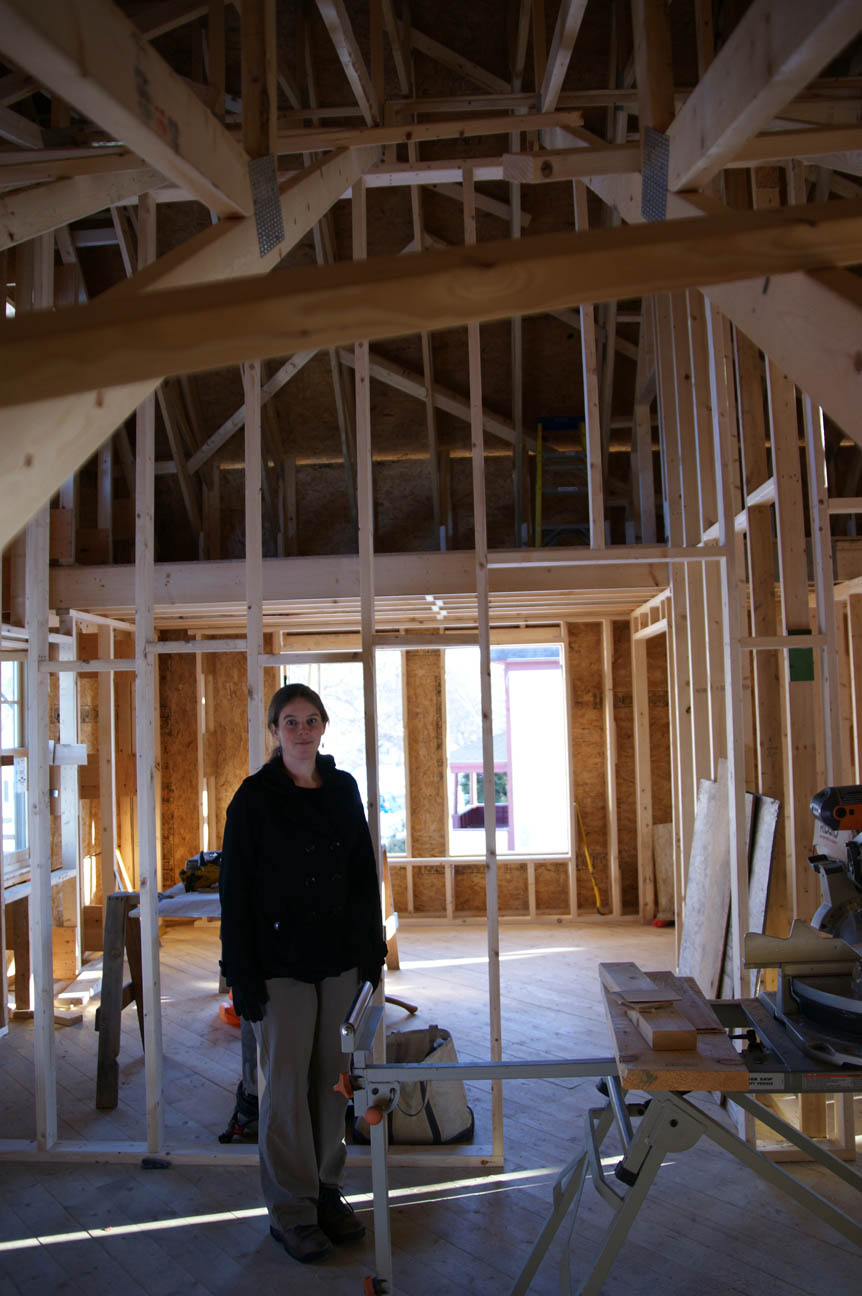
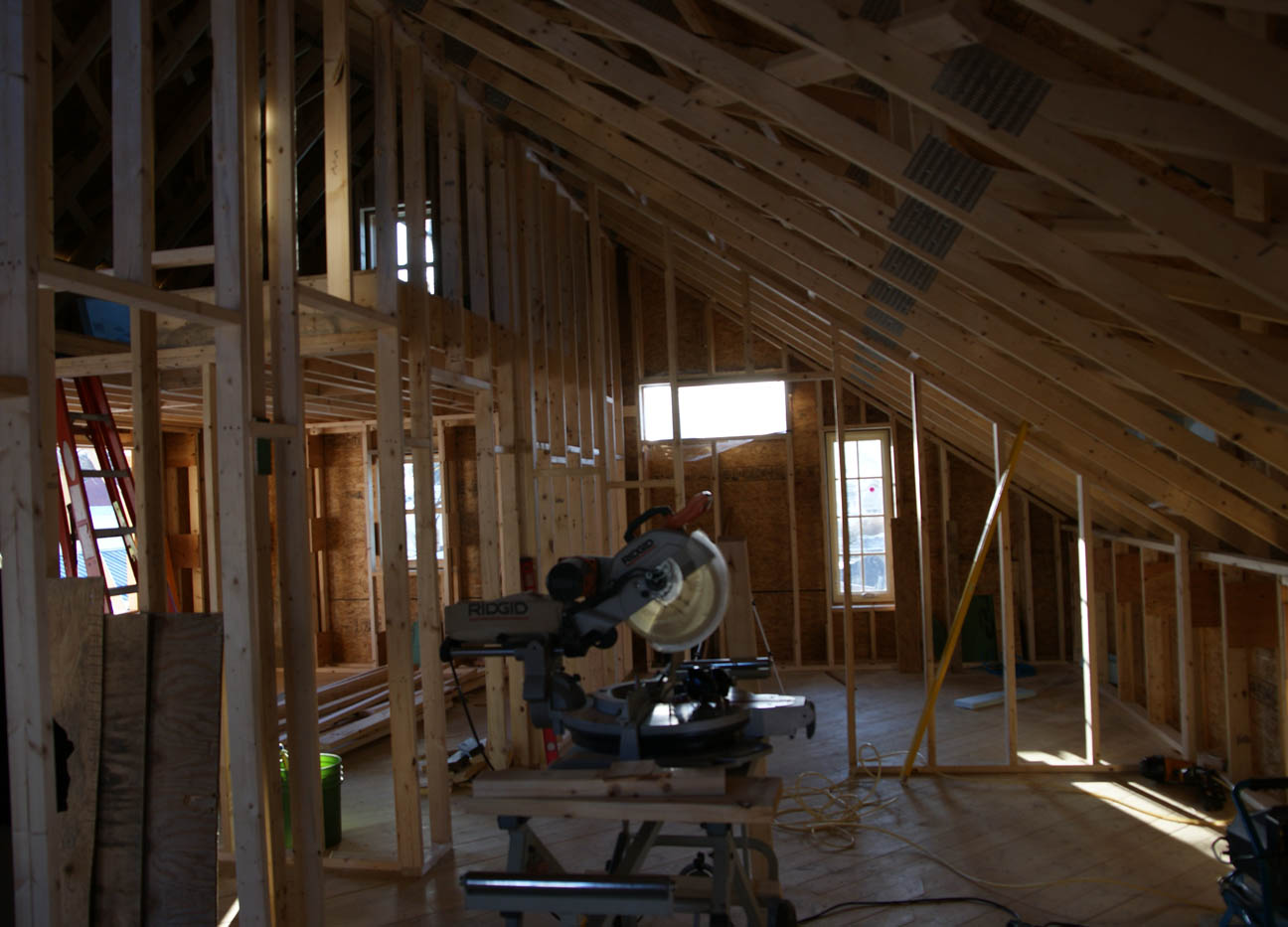
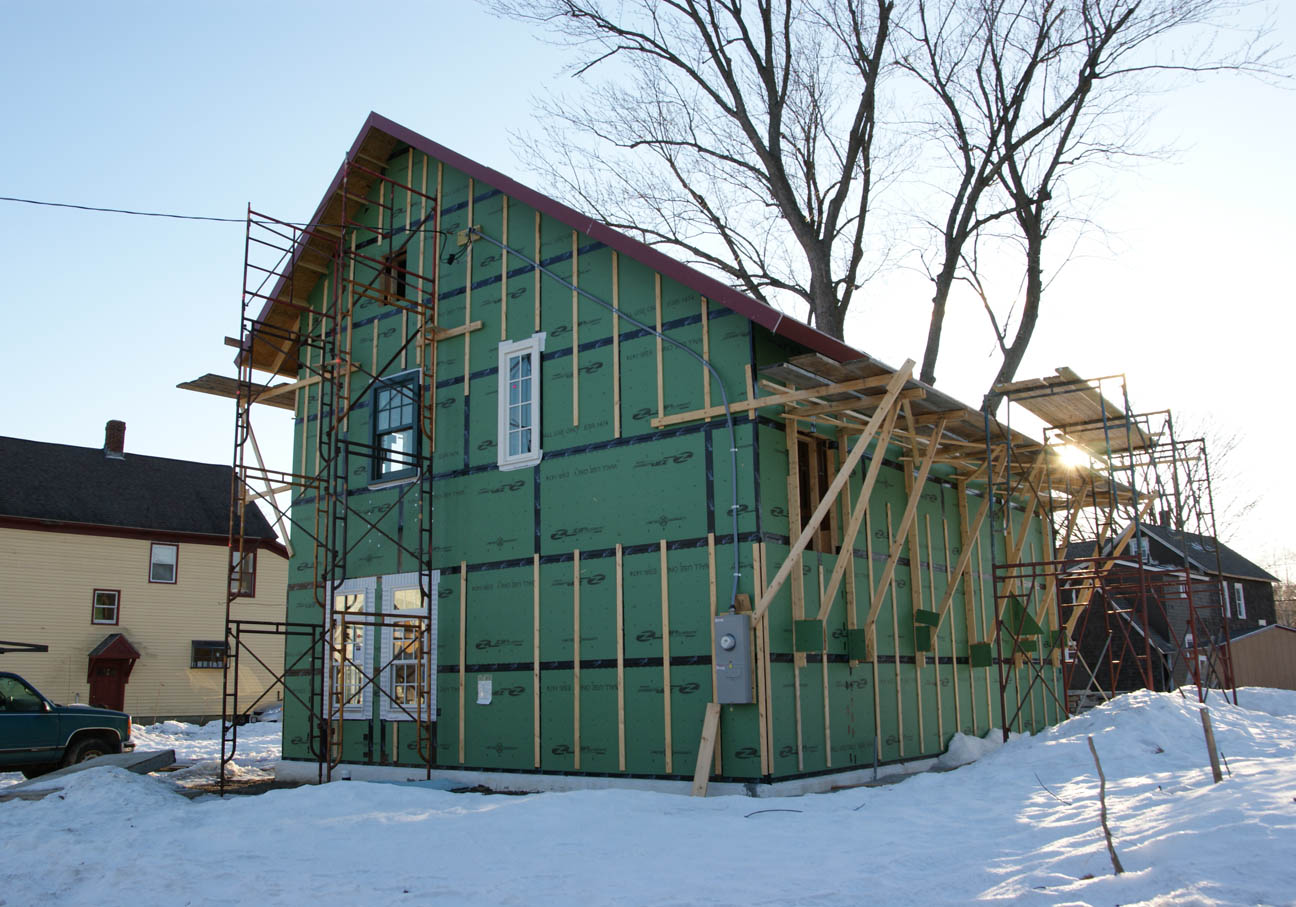
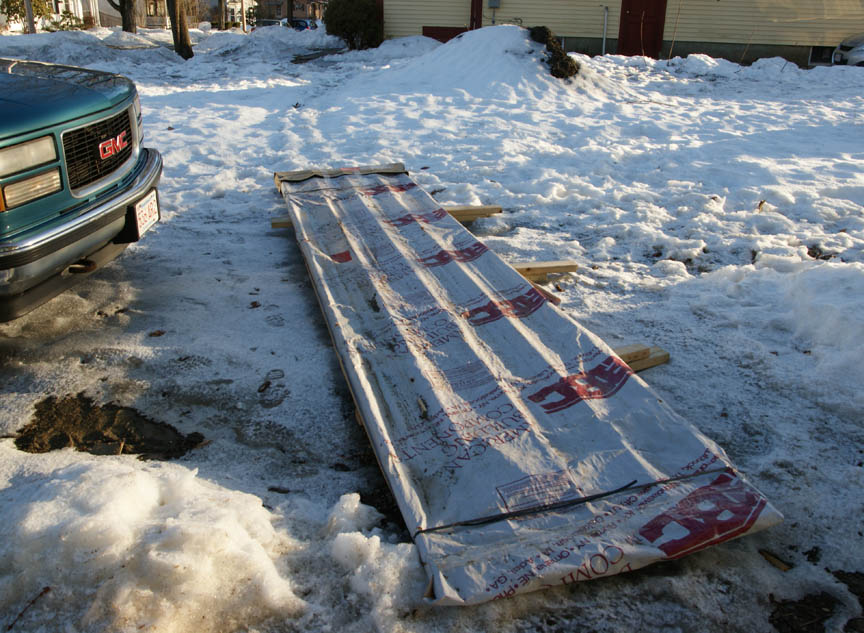
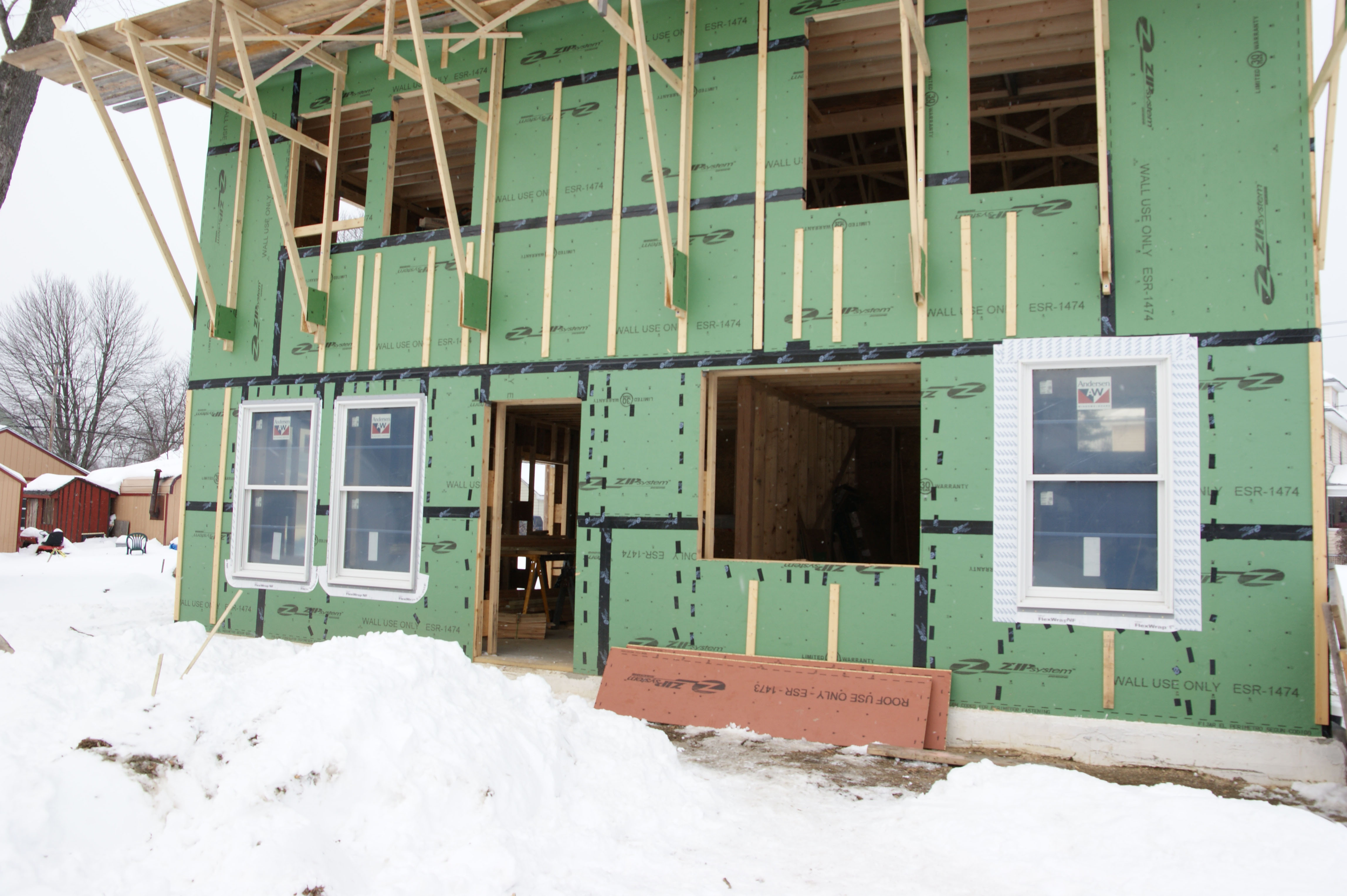
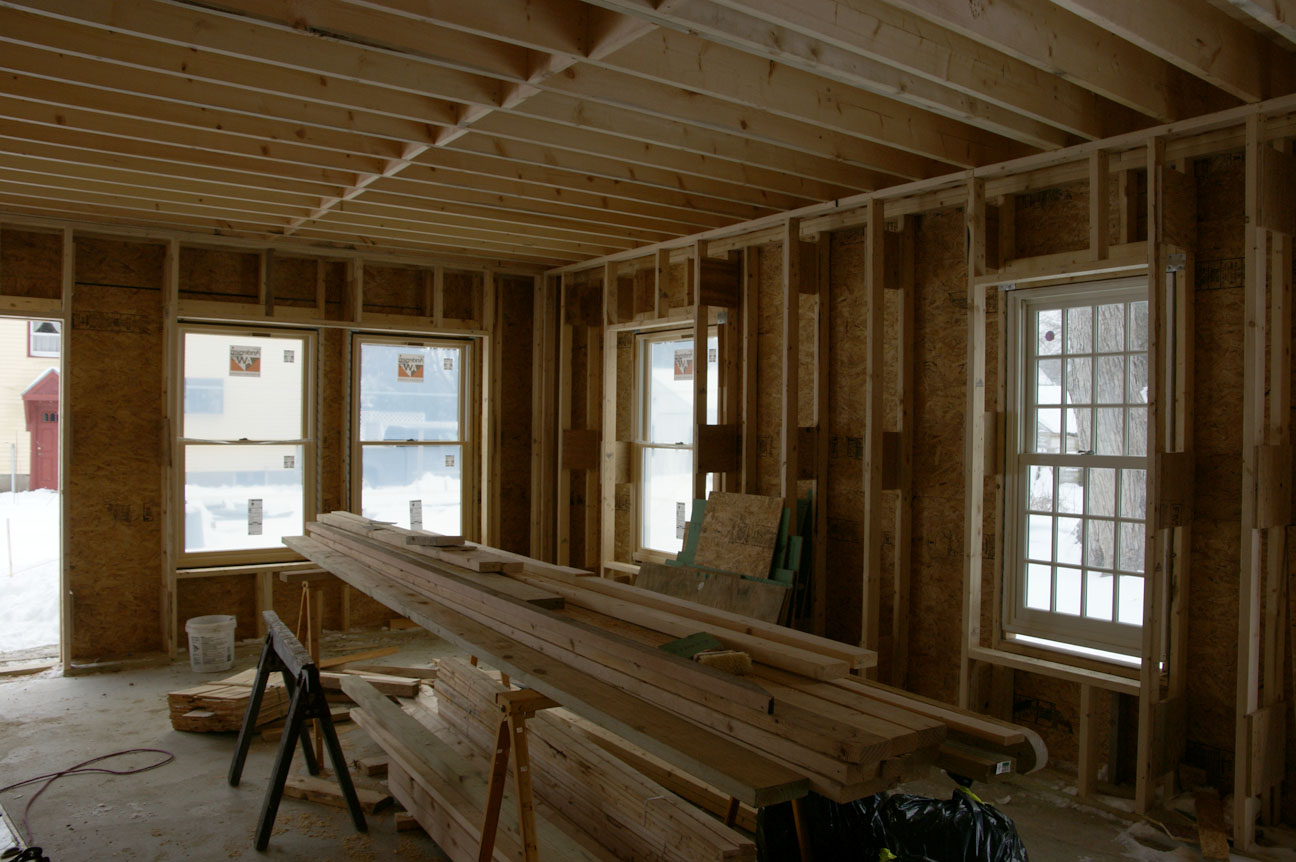
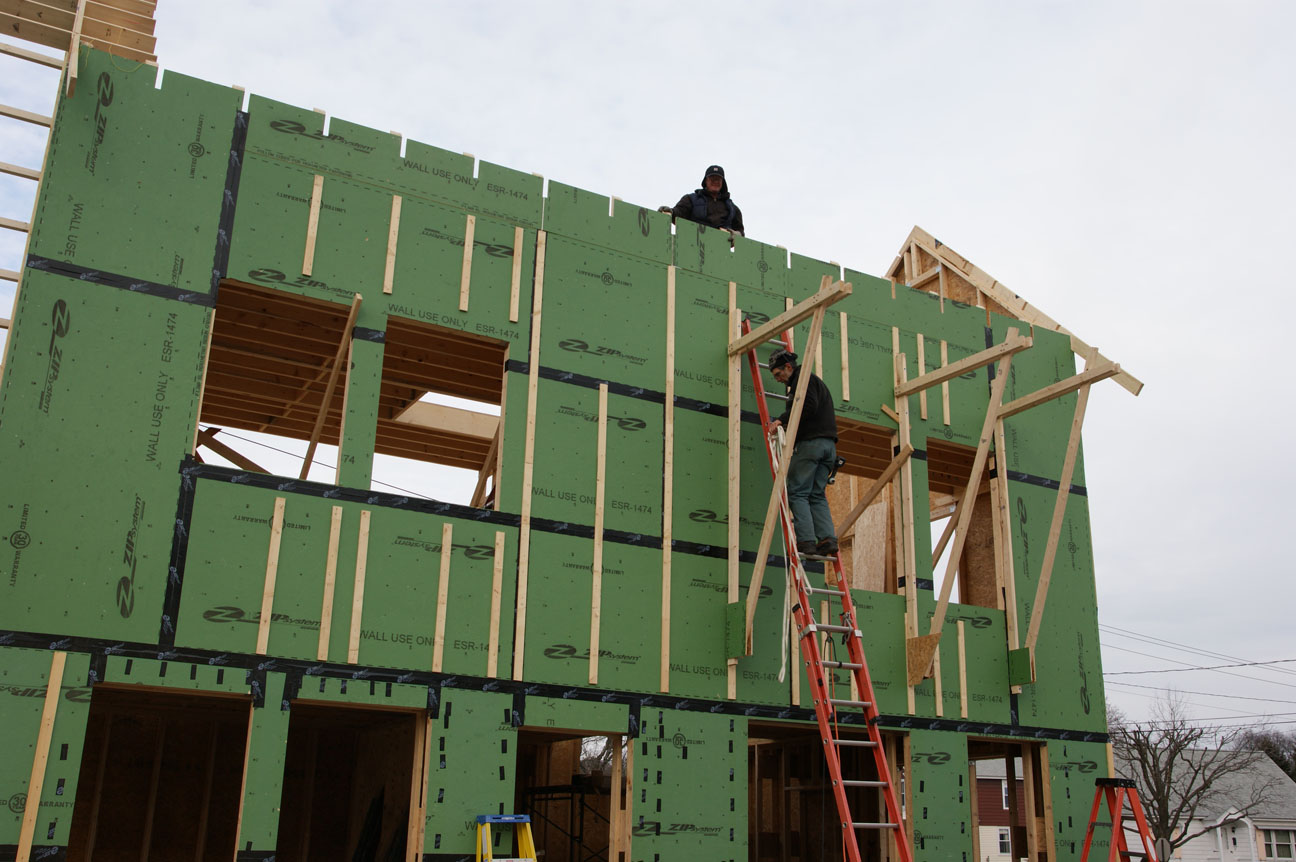
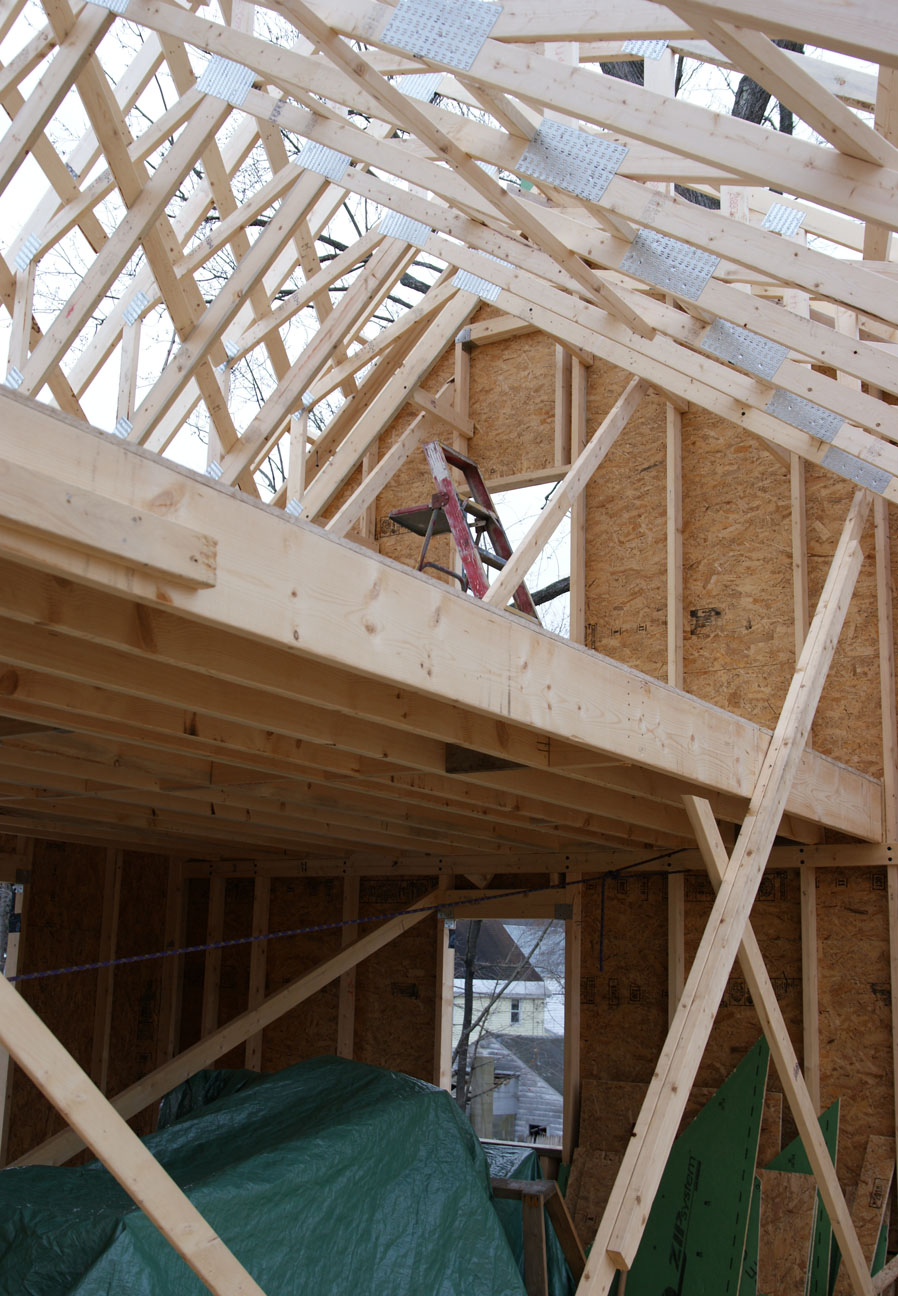
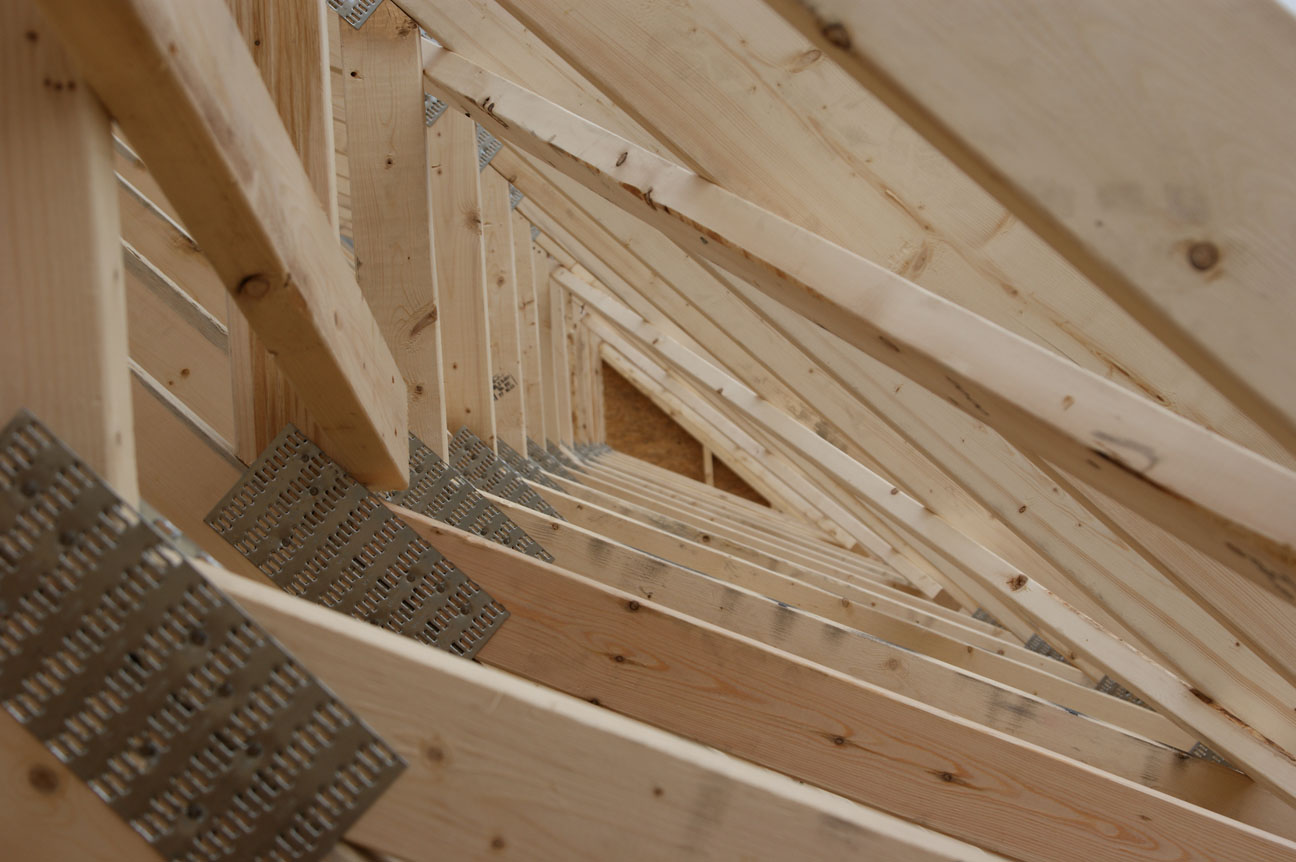
Yesterday Adam and I took down the built-on staging on the south side of the house. We then installed the four second floor south-facing windows. It was really nice to be able to lock the door at the end of the day and leave all of our tools out and a big mess. I really should have made the first floor secure a while ago.
Category Archives: Uncategorized
First floor secure; Pictures of the roof
Over the past few days I finally got around to cleaning up and securing the first floor. Hannah helped me install the two temporary doors and picture window. The picture window that we installed was the one that was originally intended for the space, but we would have had to build a jamb for it. The triple pane window that will replace it (and the other four windows on order for the same manufacturer) should be in soon. Last week I spent a fair amount of time doing desk work; researching solar hot water (details below), researching how to build the tiled walk in shower, modeling first floor partition walls (which I plan on beginning to construct this week). I also calculated the amount of cellulose insulation the house will be needing. I came up with 658 bales or 4081 cubic feet of cellulose at an installed density of 3.5 lbs per cubic foot. In order to accurately figure this out I calculated the volume of each wall and the roof, and subtracted out every piece of wood and all of the windows and doors. I was pleased to see that the percent of the wall that is wood averages at 8.3%. This compared to about 20% for standard framing construction (see http://oikos.com/library/wall_framing/index.html). You can see my spreadsheet here: Wall makeup break down and cellulose requirements for house. Unfortunately, I also learned that the cost of this much cellulose is far more than what I was expecting. At roughly $13 per bale, the insulation alone will run over $8000.

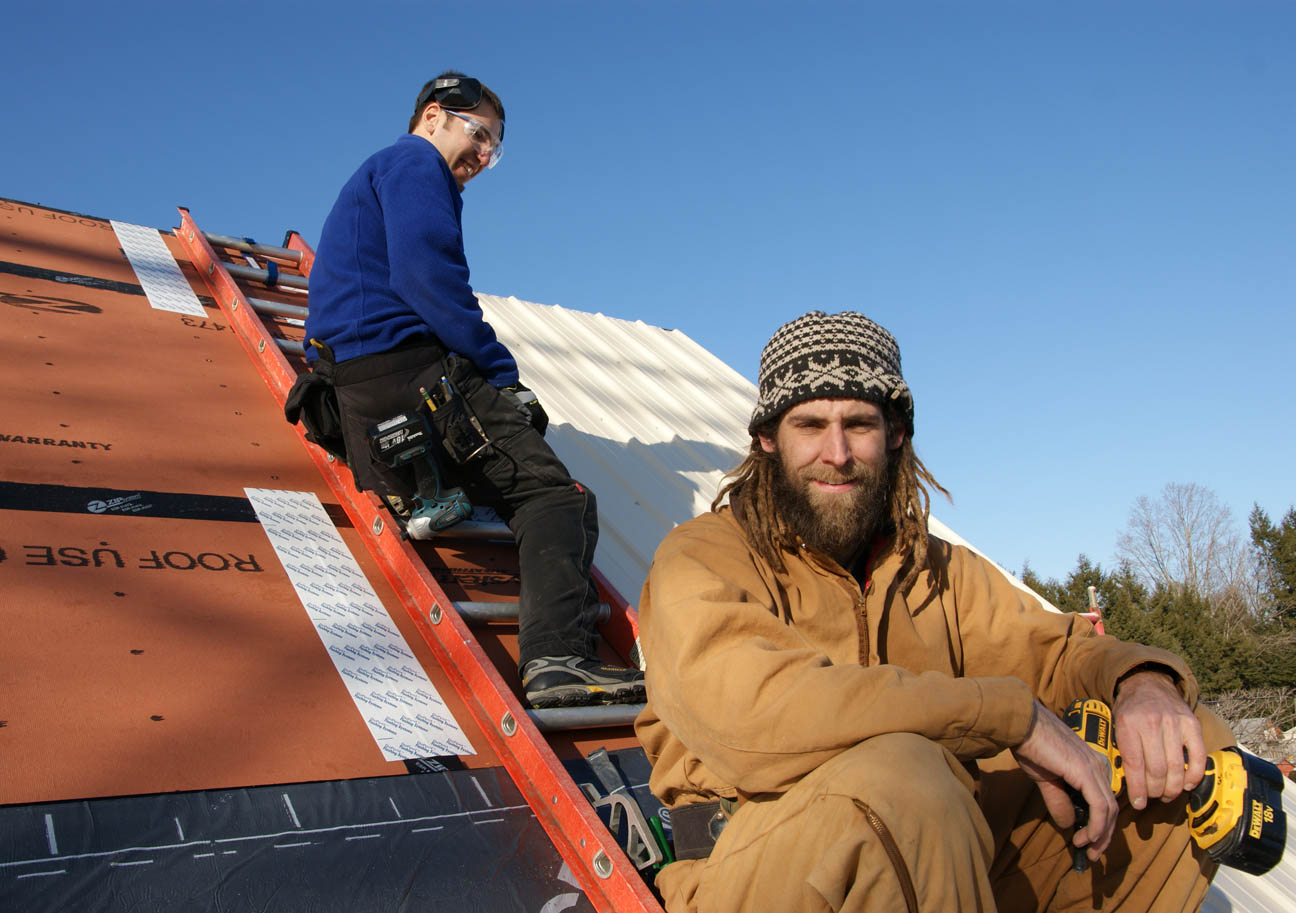
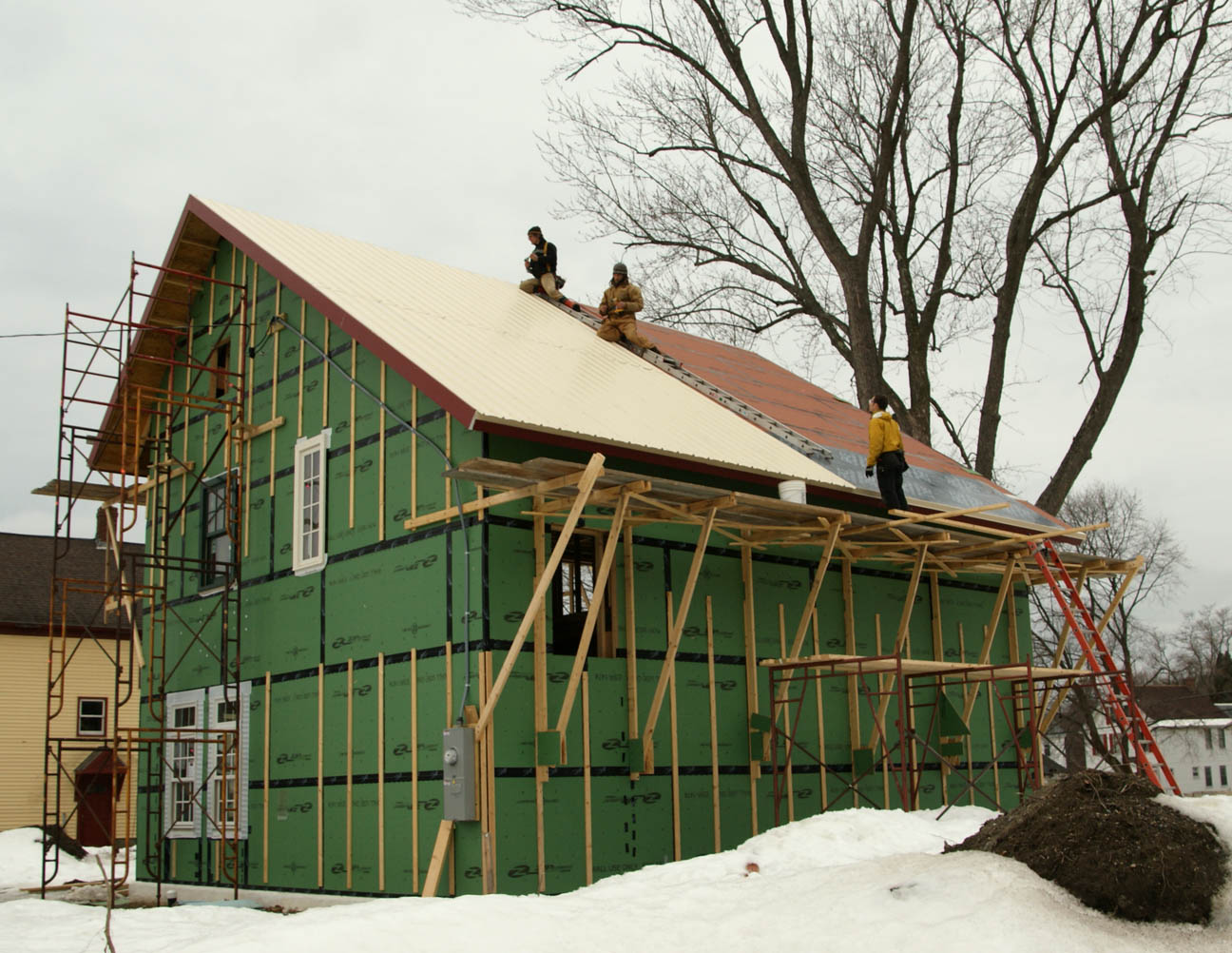
Here is the screw down metal roof all done with ridge cap. We are pleased with the color, which will reflect more heat and sun than other colors, decreasing the urban heat island affect. Also, since the roof isn’t vented (hot roof), it will hopefully serve to keep the temperature down. Some folks have asked if there are screws through the metal how does the water stay out? Every screw has a rubber washer already on it. We will still need to get back up there to install the solar hot water panels and stink pipe. Last week I confirmed that I was not going to be able to use my professor’s home made solar hot water drain back tank. I also confirmed that the Simple Drain Back tank, is also not approved by the state of Massachusetts. After talking with an official at the state plumbing board, I learned that it is a fairly cheap and supposedly quick process to get one’s products approved. I communicated this to the manufacturer of the simple drain back system who is currently looking into getting the tank certified. (photo by Hannah)

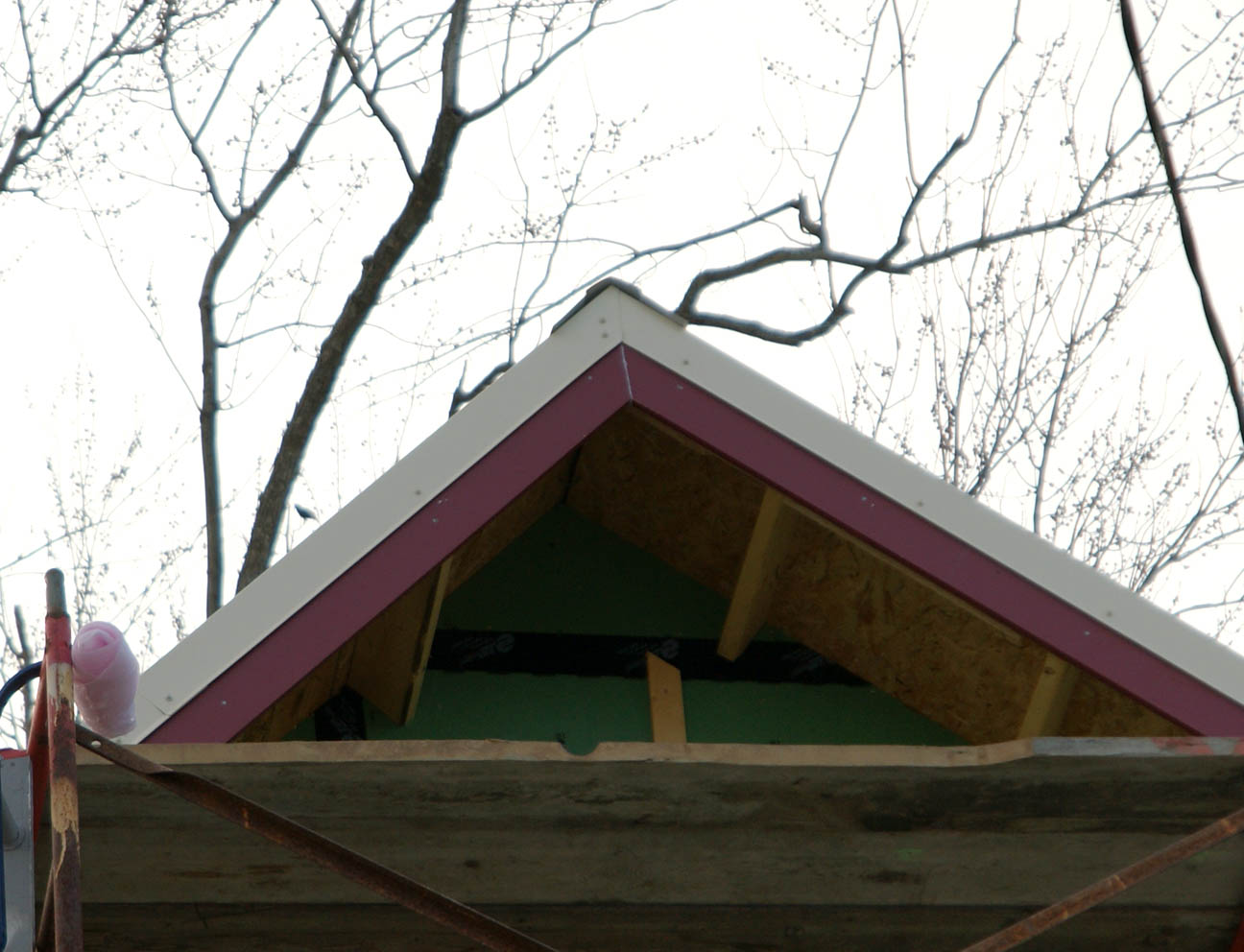
The gable peak has the metal roof wrap around the fascia boards. The underside of the soffit still needs to be boxed in. We will use AC plywood for this task–cheap and quick. We will then put up architectural brackets (see pics and explanation below) to make it look pretty. (photo by Hannah)

Here is a house with architectural brackets on the eave and gable roof lines. Ordinarily, one sees them only on the gable–ostensibly because they are providing support to the lookouts (overhang). The eave, being on an angle, doesn’t require such strong support. I mention this because we would also like to put brackets on the eave. The brackets pictured here are, of course, much more ornate than what we would be installing. This home is in Greenfield, MA.
Metal roof done
Adam and I finished the metal roof today. It looks really good; I’ll take some pictures soon.
I realized that I should get on top of ordering solar hot water panels so we can install them with the existing staging. Also, I recently learned that I won’t be able to use the solar hot water tank that my professor made–the plumbing inspector won’t allow it. Thankfully, my professor is willing to take it back. Here is a link to the new tank that I am planning on getting: http://www.solarheatexchangemanufacturing.com/NewFiles/80galdb.html
Meanwhile, I will continue to put up partition walls.
Installing the metal roof
On Tuesday we began installing the metal roof. Guy showed up in the morning and we finished installing the fascia boards, we installed the eave end flashing, and put on the Grace Ice and Water Shield. The Grace really isn’t needed, but we had to put it on to adhere to building codes. Its purpose is to protect the bottom edge of the roof from ice dams, but the house will never have ice dams for a variety of reasons: the amount of insulation, the roof is metal with a steep pitch (snow will slide off), and there are no gutters. Hopefully code will catch up on this mark.
Devin (who is proud of the fact that he has done a number of metal roofs in the last year) arrived in the early afternoon and we began putting it on! By the end of Tuesday we were half-way done with the South roof. On Wednesday we had help from Guy, Devin, Craig, and Adam. Unfortunately, we were not able to finish. There are three more panels to put on as well as the gable fascia board flashing and the ridge cap. This morning I put tape over the ridge to keep out the rain that we will be getting today and tomorrow. Adam and I will finish the roof up on Sunday.
Thank you Devin, Guy, Adam, and Craig!

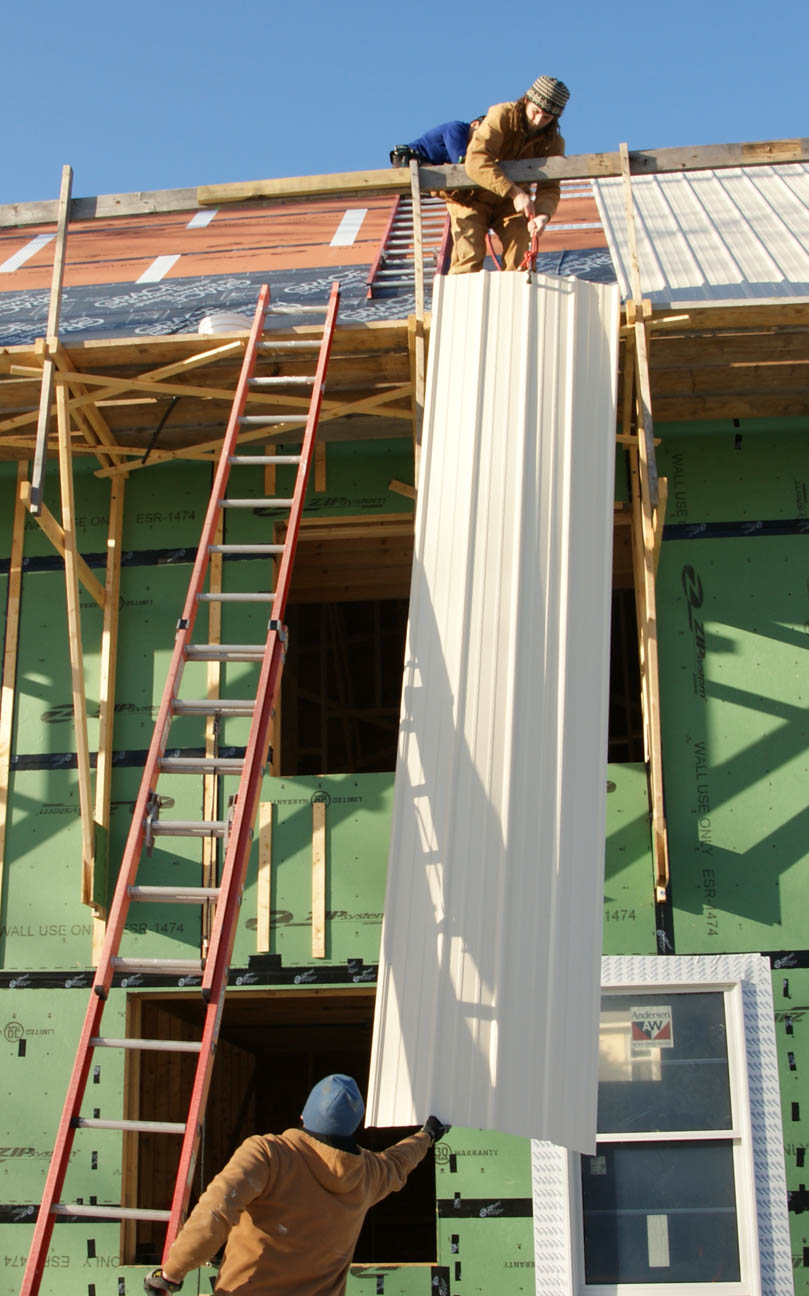
Guy, Devin, and Spartan installing the metal panel. Reaching over three feet to put in the furthest screw was challenging since the screw had to puncture the metal. On Adam's suggestion, we predrilled holes for the north-facing roof.
Last few weeks – Interior Framing
Things have been moving a little slowly this past couple of weeks–Hannah had vacation, and visiting with friends.
I have continued to plug away at the second and third floor partition walls, we put in a couple more windows, and we are finally making a push towards putting on the metal roof, which earlier today was delivered.
Using Photoshop to help visualize trim colors, Hannah and I picked out a flavor of red for the trim. I purchased 1×8 pre-primed pine for the fascia boards and began painting them in my parents garage where I could use a propane space heater to keep the temperature up. Even though I followed the directions provided by California Paint for application, several days later the paint was still peeling off like a skin. After getting unsatisfactory answers from the manufacturer I returned the painted boards and paint to RK Miles. The second time went better, but this time I used Ben Moore’s Aura paint–rather expensive, but if their warranty speaks to how long it should last, then it is probably worth it.
Installation went smoothly. With Adam’s help, and Rob’s pipe staging under our feet, we installed 3 out of four sides last Friday.
I was hoping to start moving towards putting on the metal roof today, but the windy weather was prohibitive. Also, last night we had a big downpour of rain. Even though the Zip Tape on the roof kept out previous weather, there were a half a dozen leaks. I suspect that tape was punctured during installation. To remedy this I have purchased 6″ Dupont flashing tape which is much more durable than the Zip tape. We will go over all of the seams with a second layer of tape. I considered redoing the roof with tar paper, which would certainly keep out the water, but it would not keep out air leaks.
Devin, Guy, and Craig are all scheduled to help put on the metal roof this week.
Latest
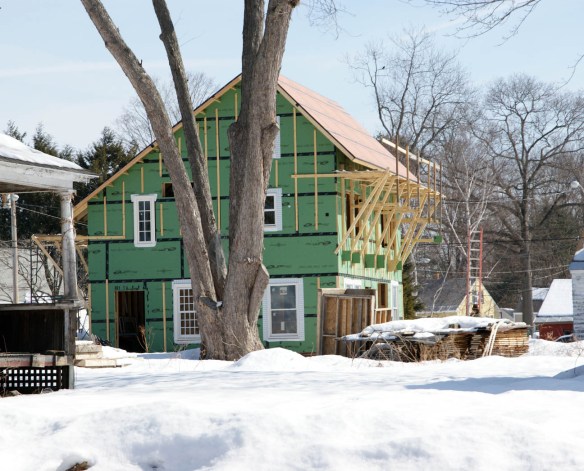
The last few weeks have been slow and steady mixed with lots of snow shoveling. I have been working primarily by myself now that we have the roof on. The big news is, as of January 26th we have had electricity–no more 100 foot extension cords run from our neighbor’s house! We got hooked up just in time, our neighbor, Sue, sold her house on February 4th. We will miss Sue. She has been extremely generous; not only letting us use her electricity and water spigot, but also allowing us to use her bathroom, and dining room (so we can eat lunch in the warmth).
I have finished the double stud walls on the second and third floors, and I am ready to move on to partition walls. The weather finally warmed up in the last two days, allowing us to move forward with window installation. The adhesive on the flashing tape doesn’t stick in the cold weather and it has been too cold to install it. Guy came up today and we installed five more windows bringing the total to 10 windows installed; 10 more to go. Six of the remaining ten are brand new triple pane windows (unlike all the recycled windows in the rest of the home). The windows are made by Serious, and their R values range from 4.2-5.9 depending on whether or not they are fixed, casement, single hung, or high solar heat gain glass. Serious uses plastic film for their interior panes, which reduces both their cost and weight. We won’t be able to install any of the second floor north or south windows until the metal roof is on. The temporary staging that allows us to work at the eaves of the roof is built in around the windows.
Buying the metal roof has been a fairly drawn out process. It has been difficult to learn about–the manufacturer (ABC) doesn’t want to talk to end-users, and the staff at RK Miles, though very helpful, don’t know all of the details. We are pretty sure at this point what dimensions and flashing materials to order, but after a week and a half, we have been unable to set up a meeting with the manufacturer’s sales rep.
Installing windows, electrical work
In the last week we have made more good progress. We have begun installing windows. I have been working on the second floor double walls. Rob, our electrician came out today to install the meter socket, electrical panel, and weather head.

Thank goodness we got the roof on before the storm a few days ago. We got about 16 inches! Thank you Greg for plowing us a parking spot in the front.

Windows! Before we can install our windows we pay a lot of attention to flashing. The general idea is to prepare for the eventuality that the flashing or the window itself might leak at some point during its life. Therefore, we want the water to drain out the bottom. We begin by tacking a clapboard down onto the window sill creating a positive drain slope to the exterior. Then, we install a piece of flexible stretchy flashing tape that can go continuously around the corners of the bottom. This is called our sill pan and you can see it installed in the window at the right. If we had used a house wrap, its flaps would protect the sides of the window rough opening, however, since we used the Zip system (the green sheathing) we applied 6" flashing tape to the sides of the rough opening. We aren't worried about protecting the underside of the header with tape since water is unlikely to come through the rough opening there, and if it does, it will quickly move down. After we put the window in, we apply 6" flashing tape over the side flanges and then the top flange of the window. It is important not to put any tape on the bottom flange so that the sill pan can drain to the outside. It is also important to note that we did not use any caulk. Although many knowledgeable builders do seal the window to the house with caulk behind the flange, Joe Lstiburek, a renowned building scientist, calls the practice "unnecessary and dumb". The tape, and the spray foam is an adequate seal from air and water.
Link to article by Joe Lstiburek about window flashing: http://www.buildingscience.com/

The south windows are Andersons that I got off of Craigs list. The one on the right is completely done. The two on the left still need to be flashed. Although I purchased a window from Renew for the large opening in the middle, I have decided not to use it since it would require building a jamb. I only paid $100 for the glass anyways.

We also installed the two first floor west windows. The window on the left is a Marvin window with true divided lights--very spiffy.

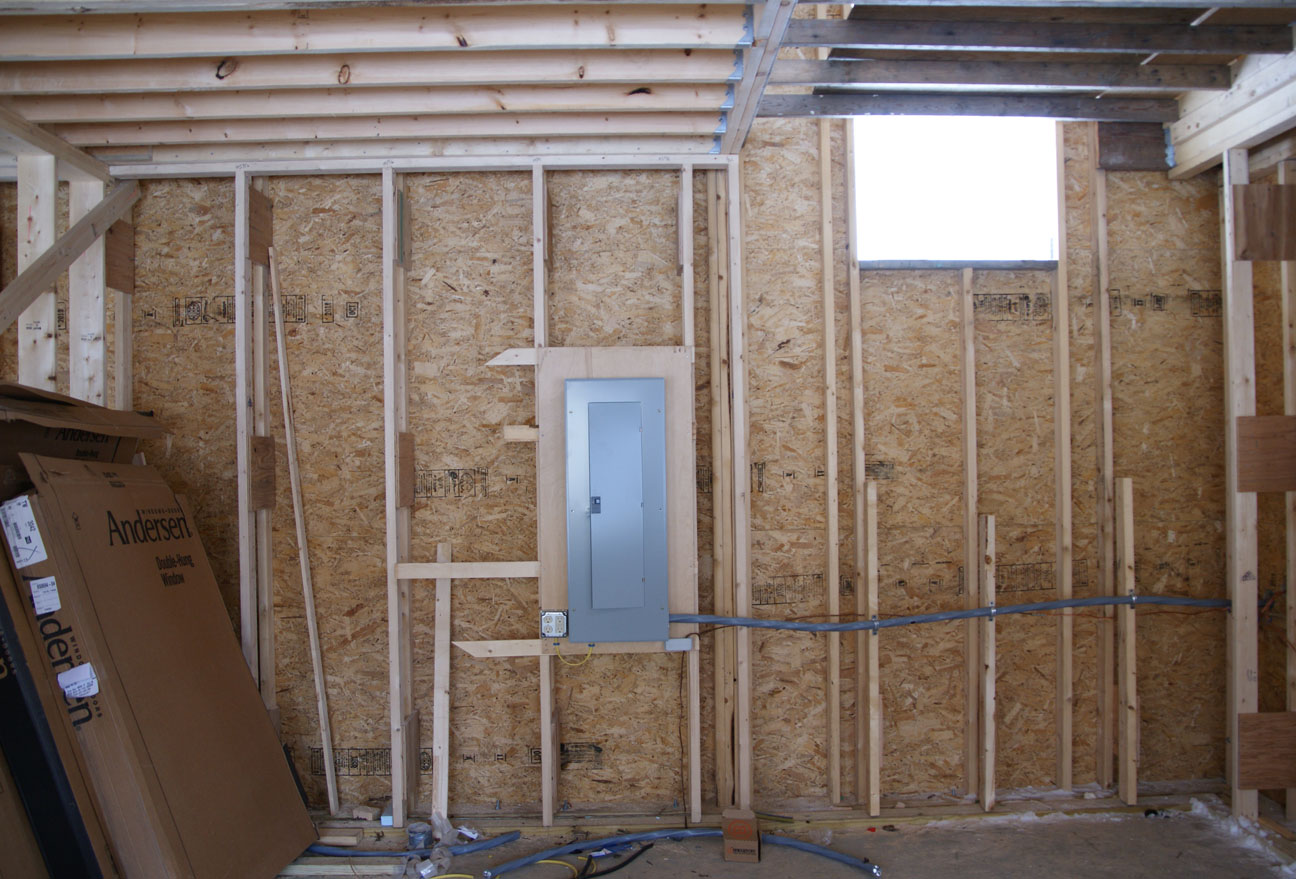
Rob, our electrician, came out today to install the weather head, and meter socket (visible here), as well as the electrical panel. In all, we spent 5 hours out in the cold. I have decided that if I am going to work in the cold I would rather do carpentry than electrical work.
We’ve been busy!
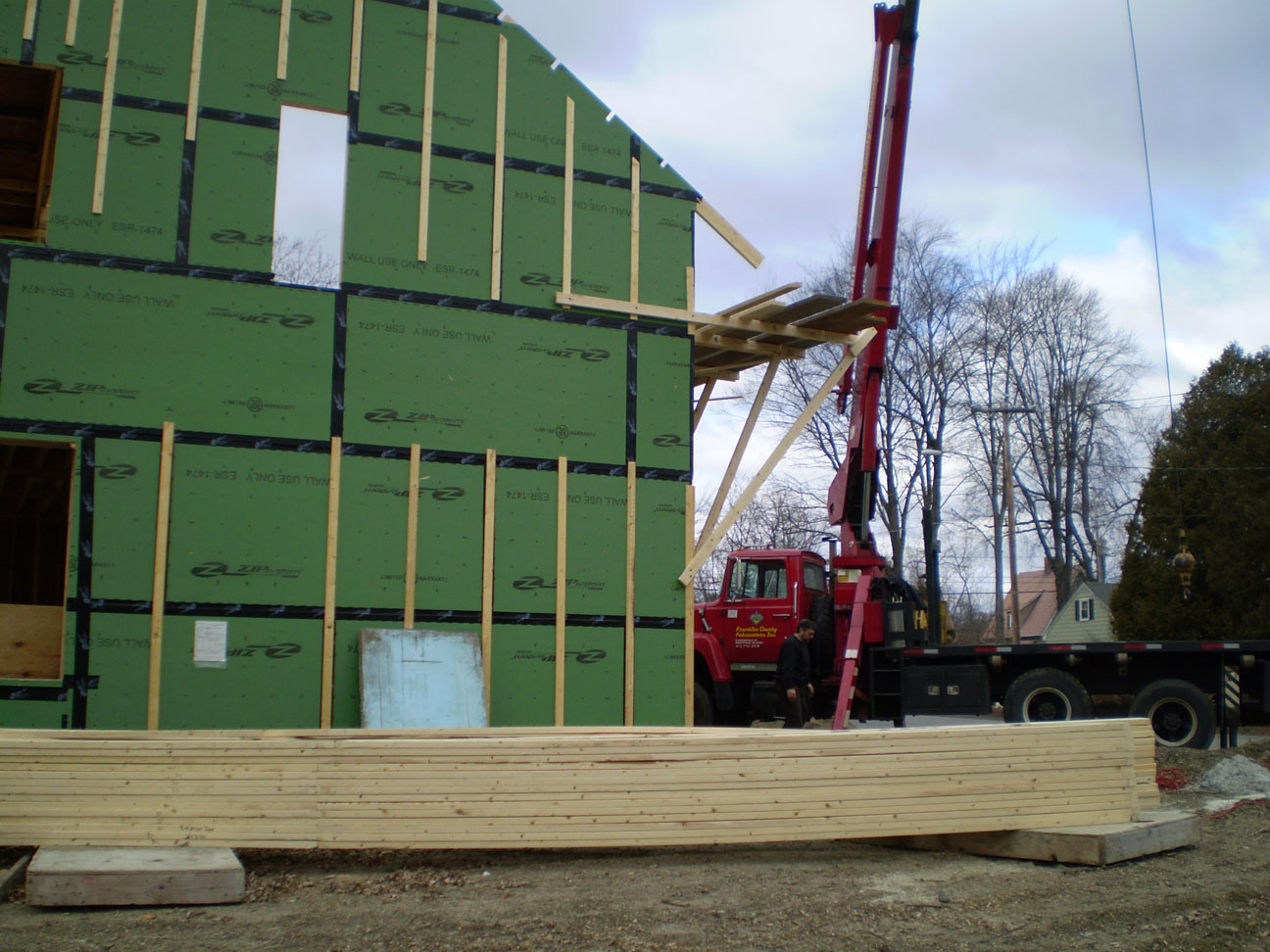
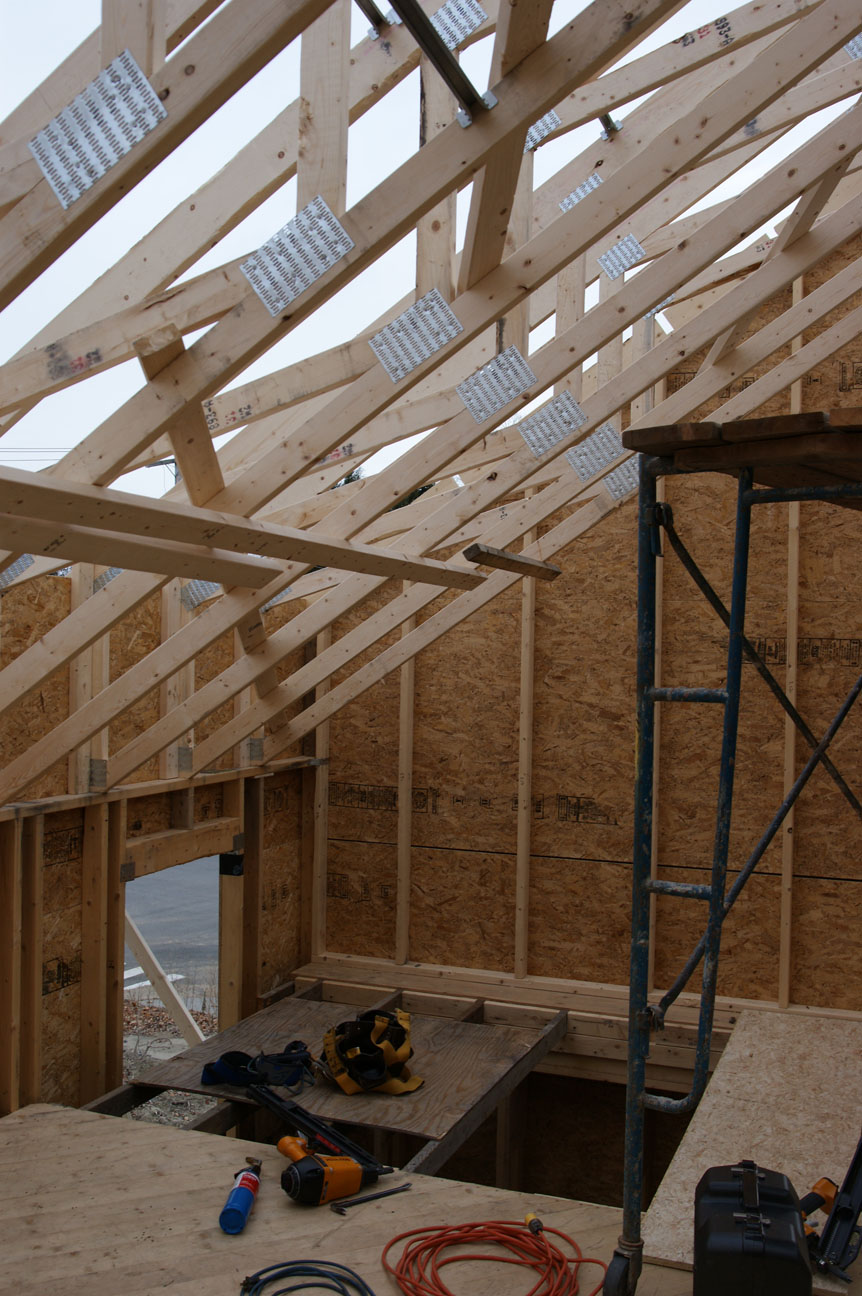
A lot has happened in the last couple of weeks. The trusses were delivered. We put up staging on the north and south sides of the house. Spent a lot of time making sure the walls were straight and true. We put on the lookouts (the wood the supports the gable overhang). We hired a crane and had a small work party to put up the trusses on 12-22-2010. Thank you to Craig, Devin, Adam, and Eric for helping with installing the trusses. We had our first snow storm, which means I can now say that I have shoveled the master bedroom. Finally, during the last week of December we sped through installing the roof sheathing!
Although I neglected to get a photograph of the shadow play on the house during the solstice, I did pay close attention to it. I am pleased to report that the shadow of the neighbor’s chimney traveled just under our first floor windows.
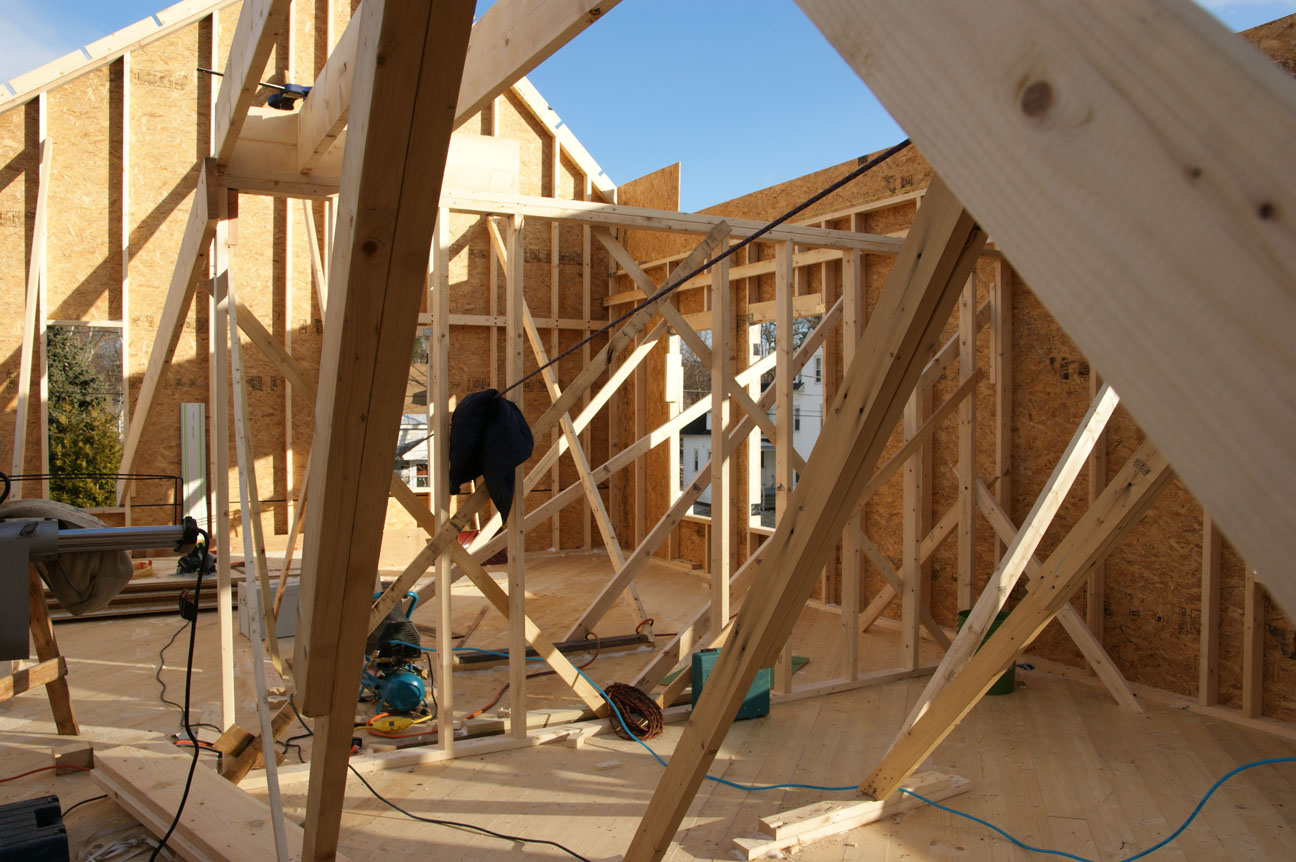
Our next steps will be to work towards installing windows.
Trusses
The trusses have arrived and we will, weather permitting, be installing them either Wednesday or Thursday this week. Unfortunately, due the size and shape of the trusses as well as the height we won’t be able to have a work party to install them. Instead, we will be hiring a crane. So far I have two quotes coming in at $150/hr.